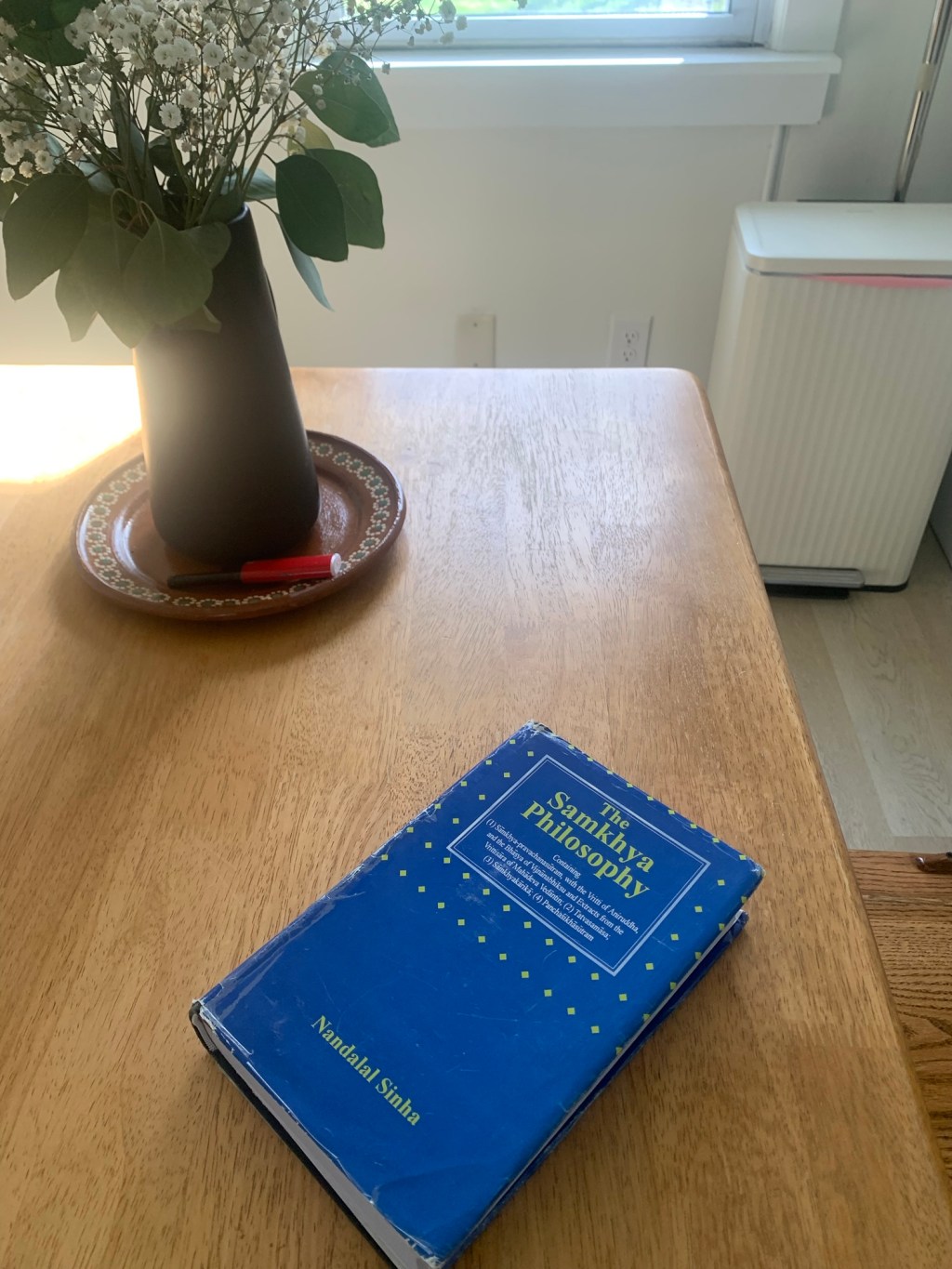
I just finished, perhaps, the most consequential book I have read in a very long time, perhaps even more consequential than Aristotle’s Metaphysics in philosophy, the Bhagavad-Gita in religion or Nietzsche’s Thus Spoke Zarathustra in poetry. I’m referring to the Samkhya philosophy coming to us as the Prava Chana Sutra.
The world may not know much about this book, but it is, in so many ways, the very essence of Patanjali’s Yoga sutras. In short, Yoga is to praxis (practice) what Samkhya is to gnosis (theory). The Samkhya system is the theoretical framework that ultimately leads us to the yoga system.
This book is all in one: metaphysics, epistemology, psychology and eschatology. The absence of an extra-sensorial deity or God or a theistic system does not make Samkhya and Yoga less religious, but the very refinement or goal of religious inclinations, that is, the removal of illusions and impairments to cognition of which are dullness and egoity. The reason we do Yoga is to think better, to value the world better, make a realistic assessment of it, and to act and emote better so that we find our ultimate work fulfilled while we live. Through yoga, we become more Sattvic. (I will explain later what that means).
The book starts with a very bold statement: “the ultimate purpose of life is to avoid the avoidable (future pain); which is the same as to be Released.” And out the window go all existentialisms, all nihilisms and all absurdisms. Aristotle, for example, says that all things existing, that is, perceivable, exist in participation of four causes: material, formal, efficient, and final. However, he never posits a final cause (or goal) to human existence, or he does so in very vague terms such as that of virtue or happiness. But, what does this happiness consists of? How can we attain it? What if we do not attain it, as the majority will not? Would have we wasted our life in that case? Well, I don’t think he may have a system to explain it all, and if so, it is less comprehensive and short-sighted, in my estimation.
So, what is, in short, Samkhya teaching us?
First, that the world as it is perceived consists of the interaction of two different Tattvas or principles: Purusha and Prakriti. Purusha is pure consciousness, of which Intelligence and Illumination are its very essence, and remains without attributes. Prakriti is both the phenomena we perceive and the underlying root wherefrom it all comes, the noumena (in Kantian terms). Prakriti, when not in conjunction with Purusha or consciousness, is in a state of equilibrium, unperturbed, unperceived, latent, but as soon as conjunction is possible, it sets into motion, creating, maintaining and destroying the universe. Prakriti consists of the three Gunas of Tamas, Rajas and Sattva, that is, the principle for inertia, dullness or darkness, the principle for movement, action and pain, and, lastly, the principle for balance, pleasure and ascertainment; and they are its very essence, not attributes. In other words, Prakriti is prima materia, movement and form, each one separately (as when not perceived) and all combined (as when capable of being perceived as phenomena). (very similar to Aristotle’s four causes, except that efficient and final cause make one: movement).
Second, that the cause of this attachment is the Non-Discrimination of the Self from the non-Self (by Self, we also refer to consciousness, Purusha). And that, by achieving this Discrimination, an act of cognition, Release is granted. This, however, requires practice, and it’s not as easy as it seems. Mistaking the ego, for example, for the Self or an idol or any other thing or human, is, of course, an error of cognition. Not being able to achieve this cognition, we experience pleasure and pain, transformation and future rebirth. So, what are the basis for rebirth, one may ask? In short, that is the seed, the Buddhi or Sattvic or ascertaining principle that simply has shunned the ego or Ahamkara, and with it the mind (the psyche) and the body when we die. The capacity for ascertainment in the form of Buddhi remains and achieves transmigration. Otherwise, death by itself would grant everybody Release, and this cannot be granted. (I will have to come back to the logical precepts leading to the existence of rebirth in another occasion). Therefore, the goal of life is twofold: to experience (happiness and unhappiness) and for the sake of Release.
Lastly, it will go over all different evolutes that make up reality, starting with Buddhi or Mahat or ascertainment (predominantly), going through the ego or Ahamkara and the mind and ending with the Senses of Perception and Perceptible things (consisting of Tamas, dullness and darkness, materiality, predominantly). So, in my assessment, the goal of yoga is to be able to differentiate each one of this components, to test our observations of the world (externally in the form of objects or internally in the form of emotions, volitions, thoughts, etc.), and compare them with what the book postulates. If this can be corroborated with direct perception, and to what logical conclusion or inferences we can arrive, then, we would grant this form of attaining knowledge as valid. Let us see the following image:
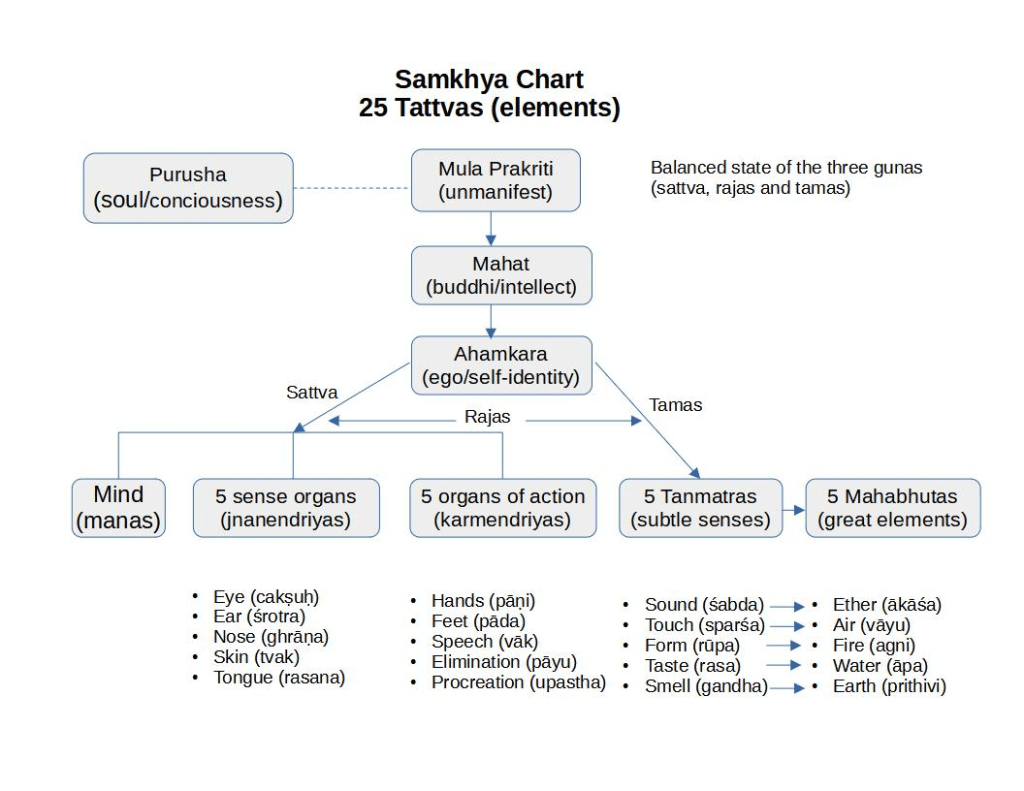
To summarize, once we have ascertained each one of this components, methodically, and Discriminate them as different from the Self, then we would have achieve true cognition and true emotion (as in Ultimate Dispassion) which will lead to Detachment which is Release from karma and future pain and rebirths. That is the goal.
This is my short, immediate, not exhaustive assessment of the book. I surely may have skipped many more important parts and refutations to different objections, but this is done in a logical way, satisfactorily, at least for me. It is 600 pages, and it will take me a while to re-read it again (as I will surely do), and digest and integrate the teachings.
Here is a video I made on the topic:
The yoga I practice, and that I teach, is based upon this theoretical framework as well as the Yoga sutras of Patanjali. If you want to join my weekly classes, text me via Instagram or email me at yourashramonline@outlook.com

 oscargnajarro