
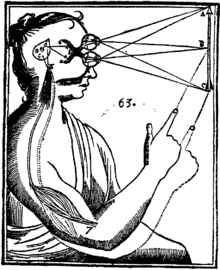
In this essay, I want to briefly explain my notions about the human psyche, what it is, what are its qualities, what causes it, what its meaning is, what can this knowledge about the psyche do for us, how can we manipulate its workings —for good, in order to enhance more goodness, or for evil, in order to prevent such evil— or whether it is even possible. In view of such questions, I will respond to them in this manner:
What’s the mind?
A working definition of the human mind —the psyche— is this, that the mind is the mechanism responsible of the dynamic flux of impressions, of perceptible phenomena, of which we have sensory perceptions, feelings, emotions, judgements, belief systems, dreams, hallucinations, deep sleep, thoughts, memories, imaginations, instincts, volitions, etc. In other words, the psyche, or the mind, consists of nothing else than a mechanism that allows the experiencing of life and the world. As simple as that.
What does it consist of?
One would naturally begin to ask important questions about this mechanism and about these impressions. Where do these impressions come from? What are they? Someone could say they come from the senses or from the body. That they are made up by the brain. However, how is it that what is material, aka., a brain, can generate such “mental imagenery?” Would we grant that the brain is a projector of images? If that is so, who is the one observing these images? Another question also arises: where are these images being projected onto? What’s the substratum? Or would we say they are projected “in the air,” as if floating? How do we even know we are asking the right questions?
These are loaded questions that have been debated by both philosophers and mystics throughout the centuries. These questions pertain not only to the field of psychology (the workings of the mind), but also to metaphysics (the underlying structure of reality) and epistemology (the reliability of our ability and the means to acquire true knowledge).
For our purposes intended, we are going to assume that what we observe, the world around us as well as the world within us, all impressions, exist in the quality of moving phenomena, in the quality of being manifest. We will refer to them as “the manifest” or “manifested existence.” Whether they are real or illusory does not concern us. What concerns us is that they appear, transform and disappear, in all their variety in contraposition to an observer.
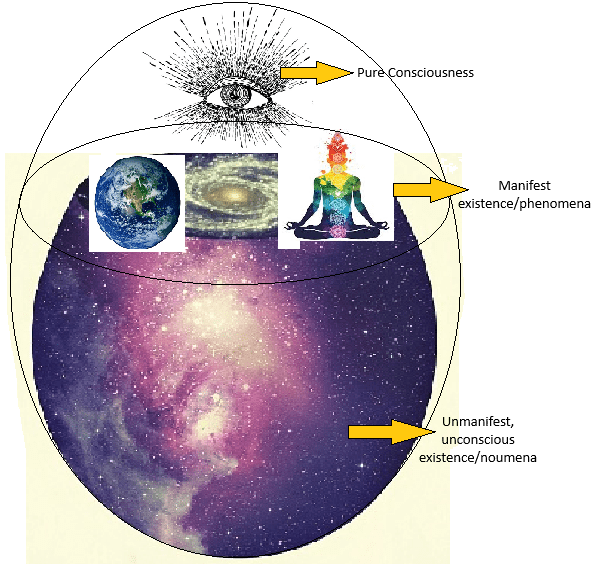
Therefore, the first differentiation we will make is that between pure consciousness, the observer, consciousness qua consciousness, and the phenomena being perceived (by the senses, both external and internal). The second differentiation consists of another element not immediately apprehended but arrived at by inference. This element is the underlying substratum that generates, upholds and destroys phenomena in all its manifestations. It is the unseen cause of the world, the Mula Prakitri of yogic philosophy, or the noumena of Kant. This is the unconscious proper, for it can never be conscious, aka., perceived by any sense (though it can be apprehended in thought as an idea). In our system, we will call it “the unmanifest” or “unmanifested existence.”
Thus, we say that the mind consists of 3 elements: pure consciousness, phenomena and unconscious noumena. See the image below.
What is consciousness?
Consciousness —or pure consciousness— is the observer. Simply as that.
We can apprehend that there’s phenomena —things moving outside, emotions and thoughts within, etc. All phenomena is a mental impression, an image, and, for that reason, it is observed. Were there not an observer, this phenomena, though existing, remains unconscious, undifferentiated and unmanifested. In other words, though things may exist in themselves, it is a if they do not if —and when— there’s no consciousness observing them, to ascertain that they do, indeed, exist. Therefore, we ascertain that the psyche consists of consciousness, pure and simple consciousness, as the illuminating element in it.
Now, whether this consciousness begins at conception or after birth, or whether it ceases after death; or whether it is the same, the one and only, consciousness on which all entities participate, or whether each entity has its own separate consciousness; or whether there exist other entities, beside myself, that have consciousness or simply appear to have it; all these, I do not know. In short, whether there exist multiple entities or just one, or if consciousness be eternal and all-pervading, or finite, does not concern us here in the present treatise. That there’s presently consciousness and phenomena to be conscious sufices us here, for now.
How do we arrive at the existence of unseen causes, the substratum of the world?
If you simply observe phenomena, you will realize that all phenomena consists of the following characteristics:
- It moves. (It has a dynamic cause, both an efficient and a final cause).
- It has inertia. (It has a material cause).
- It is apprehended. (It has a formal cause).
These are the four causes of, not only particular objects, but of the whole world and existence, according to Aristotle. In other words, nothing can be said to exist as phenomena, or as “something” perceived by the senses (another name would be “the manifest” or “manifested existence”), that does not participate of the four causes. If the 4 causes are not combined together, it is not possible for “something” to come into manifestation, be perceived by an entity.
Aristotle thought of this to apply to external objects, but, as we will see, this also applies to internal phenomena (feelings, emotions, valuations, thoughts), and it is in this way that it is understood by Samkhya philosophy in the East.
We do not have an objection to this notion, because what are the so-called external objects if not simple impressions “glued together” (though not randomly but through the working of some laws) which persist for some time, and that we later make abstract into objects (in other worlds, the object is an idea, a label that can only exist in thought). Later on, we continue our process of abstraction from the particular object into its species and genera. (I’m not saying that the object does not exist as such really, that is, externally, but that what initially comes to us are simple impressions of color, texture, form, heaviness, etc., in virtue of its inner components, “the thing-in-itself,” which we have to reconstruct, make sense of, in our mind as ideas, as representations).
In like manner, inner objects (feelings, emotions, thoughts, visions, dreams) are simple impressions not coming from the five senses but from the inner senses (as in the chakra system) which persist for some time according to some laws that explain their behavior (for we have to assume the existence of some principles that govern emotional and psychological happenings, no matter how confusing it may seem to most of us, unless we’re ready to assume it is all just chaos, which cannot be granted).
As far as impressions, both external and internal impressions are simply that: impressions. Both move and change (dynamic cause); both can be apprehended (formal cause; ex.: “it is red,” “it is a cup,” or “it is sadness,” “it is love,” etc.) and both have inertia or resistance to change (material cause). The big difference is that, for external objects, this inertia is assigned to the idea of matter. But this matter we cannot perceive. All we perceive with the senses is the heaviness, the texture, the resistance to change (the exertion of force, the pressure on the skin and the judgement that “this is uncomfortable”). Likewise, for internal “objects,” since the organs perceiving them are different (not the eye, touch, etc., but the heart, the gut, the brain, etc.), we do not say they are made out of matter, but yes, they do. For this reason: all impressions must be supported by something, be it matter or whatever. This matter is simply defined as resistance to change (so, for inner objects, what we feel is emotional or intellectual effort, the pressure on the heart or brain, etc., and the judgement that “this is uncomfortable”). Another way to understand matter is as that which is formed, that which sustains forms (or essences); also, that which sustains impressions and their transformation because it is that which is being transformed.
The whole point of all of it is this: that there’s phenomena or manifest impressions (internal and external in relation to the body, but both external in relation to pure consciousness) transpiring through consciousness but they themselves consists of causes that are unseen in isolation but do exist though unmanifest.
What are the mental impressions, phenomena, and how do we classify them?
These mental impressions fall under everything and anything that comes into consciousness —that can be observed and ascertained (as in “this is such and such a thing”). They are the images, so to say, that impress their “thing-ness” into our consciousness. We can classify them in the following way:
- Impressions are either raw perceptions —coming from the 5 senses and the many sensations coming from the intra-organic system— or their ideational duplicate, aka., ideas. For example: the redness of the apple as being seen by the eye, and the idea of redness that is created and that can be recalled from memory; or the emotion of fear as felt in the body, and the idea of fear coming from that or other similar experiences which can also be recalled from memory. The first kind, aka., raw perceptions, can only come from the external world or the intra-organic system in the moment they happen, as they happen; in other words, they come from Nature, and in this sense they are autonomous, coming to us with pressing urgency and necessarily at the moment they happen. The second kind, aka., ideas, though I don’t know how they are produced, they seem to necessitate of raw impressions first in order to create the mental image, the idea, which is stored in memory to be used by the intellect or the imagination at a later time. We can say these ideational impressions belong to the Mind proper, as understood by Western psychology.
- Impressions can also be simple or complex. By simple, I mean that they cannot be reduced further, just as the impression of redness in an apple, of pressure on the skin, of sweetness in honey, of like or dislike, of a specific pain in the stomach, of the emotion of fear, anger, love, etc. Whereas, by complex I mean that they consists of a combination of simple impressions that make up a thing, a thing that persists for some time but that nevertheless is not permanent. For example, an apple, a specific apple, consists of the simple impressions of redness, of solidity and smoothness to the touch, of the sweetness particular to that apple, of the shape and spatial depth specific to that apple. All these impressions end up making up that specific apple because they stay congruently “glued” together for some amount of time. As raw perceptions, they come in as simple perceptions from Nature, but the Mind puts them together as “that one apple.” Then, as time passes, all individual apples are abstracted away even further into the species “apple.” From this we can also conclude that all impressions coming from Nature are simple, whereas all complex impressions can only come from the Mind, though they can also be simple (rarely nowadays, though ideas must have been always simple at the dawn of the human race, before language was invented).
- There’s another way to classify them, and that is according to their level of intensity. Some impressions, because of their inner strength, strikingly press the body and the mind so that we cannot avoid noticing them. Meanwhile, because of the presence of a stronger impression, others that are constantly present are overpowered by it, so they recede to the background, being barely noticed, if at all. However, there are times when, though the impression be weak, if it is paid attention to, its intensity is increased. What is this that “focuses” and directs attention to things? We will explain later. For now, let us say that some impressions are conscious, semi-conscious or mostly-unconscious, and that only through their innate intensity or through our effort to make them conscious, what was unknown or subtle becomes clearer, ascertained.
(In my view, this applies not only to emotional effort when dealing with a neurosis, etc., but also to intellectual effort to find the yet-unknown, therefore unconscious, answer to a mathematical problem, to remember a date in history, to imagine a new song, etc. It would also apply to the effort in observing something intensely enough as during some forms of meditation. In short, intensity is granted either by the grace of Nature or by the Effort of the Will.)
- Also, we can classify them according to their level of autonomy or freedom from the influence of the ego or “I-ness.” The way in which Western psychology understands the mind is from the standpoint of the “I-ness,” of the ego —which seems to have a Will of its own. In this way, impressions are categorized as they seem to be either “me” (the “I”), or the “not-me” (because they happen irrespective of a conscious will). In other words, impressions are either what is called the ego complex or, if foreign, some other autonomous or semi-autonomous complex. These “external” complexes are experienced notwithstanding our attempt to suppress or control them. Example: dreams, day-dreams, obsessive ideas, strong emotions, neurotic symptoms, etc. So far, the study of psychology suggest that these complexes are emotionally-toned complex impressions —consisting of an emotional nucleus on top of which sense-perceptions, ideas, etc., conglomerate. These complexes are perceived by the “I” to behave as “persons” or entities with a life of their own. These emotionally toned complexes would then appear in dreams, hallucinations and other psychological phenomena as observed in the mentally ill and the so-called sane alike, though the latter to a lesser degree.
I believe we could safely ask important questions at this point. What is the ego, the “I-ness”? What is the “me” that is separate from “the other”? What its autonomy consists of? What does the autonomy of “the other” consists of. These we hope to discuss later on. What matters to us here is that there’s phenomena, impressions, which can be classified in different ways, as the ones presented in this essay, and perhaps many more.
On Western analytical school of psychology, esp. Jung.
Western analytic psychology, in Freud and in Jung (and others), does not concern with the metaphysics and epistemology of impressions. Its focus revolves around the idea of the many psychological complexes —what we have referred to as complex impressions with an emotional nucleus— that are in conflict with the ego complex —that is also a complex impression with the impression of “I-ness” as its nucleus. In turn, this ego complex is in conflict on yet another front: with the external world as perceived by the five senses.
If I observe myself well, I can tell that the two predominant states of conscious phenomena are these: 1) the state of deep/dreamless sleep and 2) wakefulness. One is a simple impression, the other is complex.
Let us not equate deep sleep to “being unconscious,” as the common expression goes (otherwise this would entail a disappearance of consciousness); but to an impression in its own right, the impression of deep sleep, which is strong enough to shut down all other impressions (simple or complex) coming from the external, and the intra-organic, world. In the same way that the redness in an apple is a simple impression; likewise, the state of deep, dreamless sleep, once it is established, is a simple impression as well —this is, at least, the way in which deep sleep is understood in the Yoga-sutras, for otherwise it would imply that consciousness has left, which cannot be granted. Now, if fainting, being knocked out, going through anesthesia, being in a comma, etc., are experiences akin to deep sleep (once deep sleep is established), then we are right in grouping them all under the deep sleep state. If some one experience is different from deep sleep, then let it be a different kind of impression of its own.
(At present, I have personally not experienced deep sleep except for when it sets in naturally. Perhaps we can learn from other’s who have gone through these exceptional experiences or from a deeper study of the human body. Also, the question may arise: is the same experience of deep sleep (once it sets in) the same as when we die? Were we in deep sleep before we were born? Could it be that we do not remember our deep sleep state just as we do not remember our wakeful state during our first years? Let the inquiry and study of deep sleep and the like states be the topic of a different treatise.)
On the other side, the wakeful state, primarily consists of the idea of “I-ness,” of separateness and “entity-ness,” of the feeling of volition, will, decision-making. This “I-ness,” however a simple impression itself, cannot exist alone for long, since it appropriates (or rejects) other simple impressions coming from the senses and intra-organic system in reference to itself —Western psychology calls it, appropriately, the ego complex, a complex idea made up of many simple ideas bound together around the idea of “I-ness.” Some of these impressions are more faithfully attached to the ego since they serve, and have served, its preservation. Others have been rejected, either because the stimuli is weak and does not serve its narrative, its story, its belief system; or because they represent a threat, real or imaginary. With the impression of “I-ness” also comes the impression of the idea of “other-ness,” of friendship or enmity, of what is pleasurable or painful, in reference to itself.
Beyond deep sleep and the ego-complex, we also observe other phenomena that have been the subject of further study in Western psychology. These phenomena is strikingly evident in pathological individuals, but they do exist, to a lesser or greater degree, in so-called healthy persons. Among these we have neurotic symptoms, hallucinations, dreams, somnambulism, fits of anger, tics, slips of the tongue, amnesia, the fight, flight or freeze mechanism, other reflexes, even muscle tenseness, spasms, etc. Some of these impressions are simple (ex: the sensation of thirst, tenseness in a muscle, feeling of anger, etc.) while others organize themselves in complexes around an emotion, and behave as if they were entities themselves, in an autonomous or semi-autonomous fashion (beyond the will of the ego). These complexes are usually organized around some specific emotional themes, remaining subliminal or dormant until something triggers them, disrupting either deep sleep, in the form of dreams, somnambulism, trance-like states, etc., or, if strong enough, the wakeful state in the form of neurotic symptoms, amnesia, slips of the tongue, etc., or even outright psychosis where the ego is completely hijacked.
Let us see the following image:
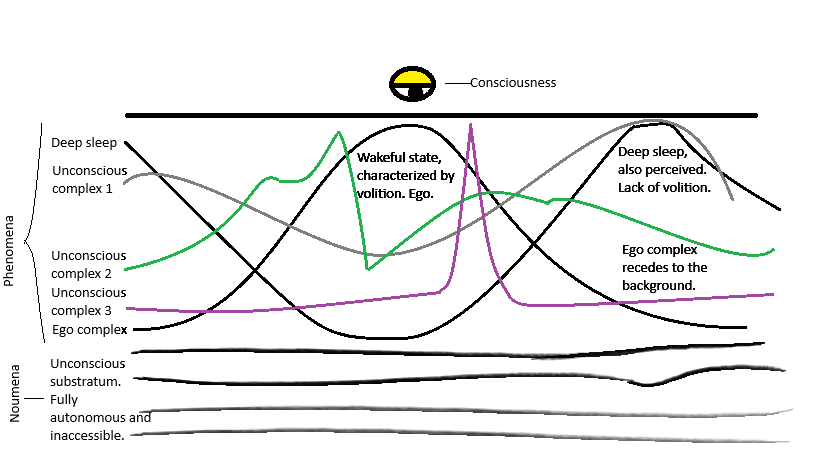
In the image above, for example, complex No. 1 could be something like sexual desire that has undergone repression during wakefulness but comes back at night to prevent or disrupt deep sleep. Instead of deep sleep, the dreamer gets sub-optimal sleep and a dream full of complex impressions around the topic of sexuality. Complex No. 2 could be something like a strong emotion after receiving some bad news that the ego pushes down in order to operate in society, though this complex remains underneath, semi-conscious, coloring the experience of the whole day. Lastly, complex No. 3 could be like a quick reflex that goes away as soon as it came. It could also be a fit of anger that needs to be repressed immediately.
A tentative diagram of man.
In view of the different impressions just explained, and in reference to Western analytical psychology, we can come up with the following diagram:
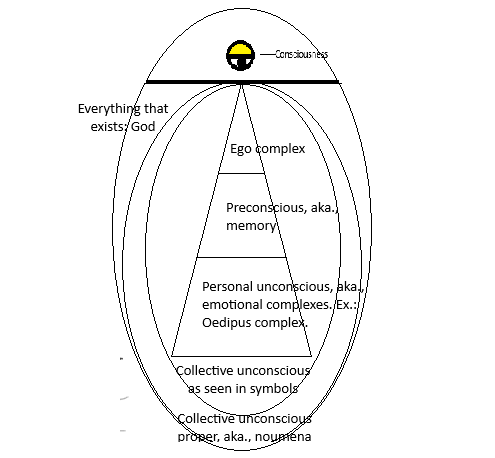
Now, Western psychology, specifically Jungian psychology, rightfully calls the ego “the center of consciousness,” and it is said that the goal of psychoanalytic practice is the increasing of this range of consciousness by making the unconscious conscious, by differentiating what was previously undifferentiated; for otherwise, these undifferentiated aspects of the personality will keep behaving as if living on their own, organizing themselves around complexes which cause so much havoc in a patient’s life.
In psychology, this unconscious that can become conscious cannot be an unconscious proper which feature (of being fully unconscious) belongs to the “noumena,” the unconscious root of the world. We believe that another good term for it is the one of “unmanifested existence.”
The unconscious to which psychology refers to is what is unconscious to the person (the patient) but that should not be so (because it is a part that should have matured but that remained underdeveloped or infantile instead). We call it the personal unconscious, which contains, for the most part, emotional complexes. This emphasis on emotion in the unconscious makes sense, of course, given that so much of our culture is based on their repression. However, we could also say that the personal unconscious should include, also, all other things unknown, either to the senses (because out of reach or out of focus) or to the intellect (because of out of reason).
The repression of emotions occurs, according to psychology, in the following way: some impressions (ex.: emotions) are rejected due to their painfulness (the impression of pain) by the workings of a “censor,” —which, to our point of view, is none other than the “organ of volition” (wherefrom the impression of volition comes). In turn, other impressions are preferred which have proven, previously, to be pleasurable (aka., infantile pleasure). The repressed emotions are thus split off the personality and forced to live “a life of their own,” unconscious to the person.
What’s the nature of this pain, or of these emotions? Why emotions are split off and not bodily aches or the same-pain of a neurosis, etc.? This, we cannot fully answer. Our suspicion goes to the fact that emotions are subtler, “fluid,” and perhaps more modifiable into their opposite (thus, an emotion is ambivalent, both pleasurable and painful). This ambivalence of emotion is also seen in what is understood to be the nucleus of all complexes: the Oedipus complex. The complex never truly goes away, but exists either in its benign, mature form, or in its malign or infantile form. This topic, however, deserves an entire essay. Perhaps some other time.
Nevertheless, the goal of therapy, we repeat, is to make the unknown emotional complexes conscious. This will, in theory, enlarge the domain of the ego to its zenith. In here, all the pseudo-personalities become integrated into one. But, of course, this enhanced ego, no matter how complete, is never truly so, because it is a part of a whole, and because not all things become under its control. Here, the ego ultimately discovers that it floats in an ocean, an ocean Carl Jung called by the name of the collective unconscious, which, according to observation (in dreams, hallucinations, world religions and mythologies, etc.), is fully autonomous, just as Nature is also fully autonomous.
The collective unconscious communicates with us through the archaic language of symbols. As such, either as visual or auditory impressions (are there any symbols that use touch, taste or smell as the basis of expression?), they are charged with deep emotion, with the strength of the instincts, and influence us in one direction or another. These instincts as well as aspirations are the pillars of human psychic life. They are unchangeable, fixed and shared by all humans.
We have to be careful with Jung’s system since, by definition, it cannot be a science. I believe that dream and symbol analysis is currently in the pre-science stage, and more study needs to be made. But let us explore some of the archetypes of the collective unconscious presented to us in dream and myth symbology: we have the Shadow, the Anima-Animus, the Old Wise Man and Woman, and the Self. The goal of Jung’s therapeutic exercise is what he called Individuation, that is, the establishment of a healthy relationship between the integrated ego-complex (devoid of any emotionally toned unconscious complexes) with everything else that cannot be integrated or absorbed into the ego, but that needs to be related to it, that is, Nature (external and internal) and the unmanifest noumena. This relationship, in theory, can be assessed and guided by the current representations, in dreams for example, of the symbols of the collective unconscious.
In summary, what is good is a growth in consciousness that conveys a dissolution of unconscious emotional complexes and a relationship to the entire Kosmos by the ego; and what is bad is the opposite, a shrinking of consciousness by the repression of emotional complexes or the identification of the ego with collective unconscious elements, that is, ego inflation.
On physics and the external world.
Likewise, it can be implied, the ego needs to make sense of the external world surrounding him, not only in clarifying what things are, by putting a name on every one thing, but by relating to them in a human way, be it separate as in wild nature or as belonging to oneself or others in the form of private property. The external world, for the most part, can be treated, by the ego, as a separate autonomous entity, to which it can be related to.
The external world is simply a recollection of sense-perceptions, though separate in themselves, that are united by a nucleus that is known in Kantian terms as the-thing-in-itself, which seems to be a conjunction of mass, as the material cause, and essence as the formal cause in objects. Which is to say that all these separate sense perceptions seem to be glued together unto a core, persisting for some time, until it transforms either substantially, or accidentally, or it moves in its location as time goes by. In a way, external objects are the complexes of the external world. Mass, at the end of the day, is a measurement of inertia, and it cannot be observed directly, but inferred only after the sense perception of physical touch and the sensation of exertion or effort (of moving an object).
We can make the analogy that emotional complexes are internal objects, that have a nucleus composed of a certain mass, which is inertia or resistance to change, and an essence, as in the fact that they can be perceived as separate from other complexes. If moving an object implies physical effort, perhaps moving an emotion implies emotional effort, or moving through ideas implies some kind of intellectual effort. Can we set ourselves to the study of internal objects in the same manner as external objects? What laws do these emotions follow that explain their behavior and change? Let us leave the question open for now.
On enlightement and Eastern philosophies.
As far as Carl Jung goes, he did not explain whether he met anyone, patient or not, or his own person, who had achieved Individuation. We understand from him, perhaps, that this process goes on and on for as long as a person lives. This is understandable. Perhaps there exists a point in a person’s life at which emotional complexes have been integrated, that is, the Shadow is nearly non-existent, but can this be the case? I believe not, however, because the Shadow, as all archetypes, always exist, and it is a universal, eternal force. Perhaps we can say that what has been achieved is the integration of the elements of the personal unconscious to the point where all is left is the relationship, not leading to ego inflation, between the ego and the rest of existence. This relationship to eternal but always changing principles is what remains for the ego to actualize until its final death. What remains seems to be an understanding of the laws of emotional life in the same way as we dominate our external world by the use of science. Perhaps, we could dominate our emotions, including the raw complexes, and transform them into refined objects of greater emotional value. This is how Individuation can be interpreted, as a never ending process because it is relational, between the limited ego and the never-ending principles.
This conclusion can be dissatisfying to some. There seems to be no finality, no redemption for the ego. However, for the East, to answer this question is easy. In the East, specifically in orthodox Hinduist philosophies like Yoga or Samkhya, the goal is a definite one, it is called Enlightenment. The process of Enlightenment, so it seems to me, entails not only the integration of emotional complexes and the management of the relationship between ego and non-ego; it also entails the growth in the direction of proper cognition which leads to the differentiation between the Self and the non-Self (to the Eastern mind, the Self is the same as to say consciousness, and not the Self of psychology which is, more or less, all in one: consciousness cojoined with everything else, ego, external world and collective unconscious). In this way, the goal of Eastern mindfulness practices is greater intellectual lucidity, and the elimination of obstacles in the form of dullness and egoity. Once a certain cognition has occurred, the goal has been achieved, a person can either simply go, leave this body, or continue living just out of mere inertia, mere karma that pushes the body until that karma is burned, as when we let a mechanical toy continue moving until its battery ceases.
To the East, what matters is not just emotional integration, but also intellectual lucidity, the seeing of things as what they are, of perceiving the relationship of the ego with everything else, and letting it all go. Once consciousness has been directly apprehended, there’s no more maintenance of such a relationship. Enlightenment implies the voluntary end of such relationship. The ego must be given away so that consciousness can rest in its own nature, and the rest, that is, the world of transformation, ceases for that one person, but it continues for everybody else. This is our interpretation, one of many, about the topic.
This is either true, or it is not. At present, it makes sense to me, but I cannot corroborate it. However, if we assume that death will wipe it all out, and Enlightenment is but unnecessary, let’s not exert ourselves in this direction. Let us live in fear, immaturity, blindness, etc., and wait for certain death to redeem us. At best, let us integrate the emotional-complexes, simply for mental health or personal growth purposes. Or, if death is not really the end of it, which is to say there’s reincarnation or a different kind of life, as if our minds could be preserved after death, then, pursuing “spiritual” Enlightenment and end the existence of the mind entirely would make sense.
Whatever the motivation be for anyone in working in these psychological matters, one thing is for certain, that is, we should integrate the emotional complexes and achieve a certain understanding of our relationship to the Kosmos. The devices and methods to achieve our ends are the same in both East and West: meditation, study, and the analysis of both waking life and dream life. Perhaps our aims can change once new insights come to us. That is, at least, the path I’m taking.
On the effort of the will.
If we understand Enlightenment as the growth of consciousness, that implies in itself Individuation, at least initially. It is also very well known that the process of integration, Individuation, or spiritual Enlightenment, is not easy, and requires a certain effort, emotional and intellectual. This effort can only be accomplished by the ego and its instrument of volition, that is free will. As we have said earlier, in the same way physical objects required an effort to be moved and transformed from raw nature into refined objects of technique and human consumption, so too, emotions, coming from raw nature, require emotional effort for their transformation. We can also imply the existence of ideational-complexes, or rather, ideologies, that can be refined further into better forms via intellectual effort.
This effort can only be accomplished by the exercise of volition, of focusing the lens of consciousness onto a thing, a project, etc. In psychology, this is known as the therapeutic process as seen in psychoanalysis, dream analysis and all sorts of talk therapy, including confession. The goal being the focusing of consciousness on the raw, though uncomfortable, emotions, and let them flow their course, that is, be abreacted. Abreaction, by itself, would heal a neurotic from his neurosis, but this does not heal fully the patient from his relationship to his or her environment, which, of course, includes his or her parents, or whatever other external factors that produce trauma. A more wholesome way of healing, in my experience, does not end with abreaction (ex.: crying, sobbing, bursts of anger, even laughter). The emotional unconscious conflict must be resolved in real life also, in our everyday experience. This makes of this unconscious emotion something now conscious. The problem becomes a moral one. The safety of the therapy or meditation room is but play, exercise. The real world is where the moral, conscious muscle is tested, in our relationship toward objects, animated beings, other humans, etc.
The same can be said also about our relationship to the Universe, in what way we can apprehend it, and perhaps discover unconscious knowledge. Socrates, after all, considered that knowledge was unconscious. If a person does not know algebra or geometry or astronomy, or any other science, it is argued that the knowledge is present there, but may need to be remembered, developed. All it would take is intellectual effort.
In theory, what happens when we do not exert effort? That dullness becomes dominant. What happens if we exert it in the wrong direction? That egoity becomes dominant (rooted in fear of death). In either case, a human being will not grow to its fullest potential. He or she will live a life oriented by wrong ideology (wrong because it achieves the opposite of what one had intended initially, that is, unhappiness instead of happiness), burdened by all kinds of neurosis, feebleness of mind and body, and, according to the East, to another life after reincarnation. Dullness and egoity have always and everywhere led humanity to different calamities. Not only individual health and happiness is of concern, but collective too.
On the other side, if exertion is directed towards the right direction, happiness is achieved, mental and bodily strength is achieved. Lastly, enlightenment is achieved, according to our Eastern friends, and no more rebirth or death or suffering to come. But, what is this right exertion? This mapping out of exertion and the different sign posts telling whether a person is going in the right direction, or not, is to be found in the writings of different mystics and saints. They all differ among themselves, but, at the same time, they all share some similarities into what we call The Hero’s Journey. Another alternative is left us, which is not to believe in what others may or may not have accomplished. All we can do is to experiment with it and see what happens, following our inner compasses of love and reasoning.
The different devices or methods that have been used to widen consciousness are widely known. Some of them are: the use of reasoning and Maieutic method for intellectual effort, the psychoanalytic methods and meditation for emotional effort, and all the other physical exercises and training in whatever skills for physical effort. All to be tested in the real world against, or in conjunction, with other people and the environment.
We have said enough about the mind. I will leave this topic hanging, because all the major questions have been answered. There’s room to narrow down our inquiries but always in view of the general topic, on the mind, articulated in this essay. The mind not only is, whatever it is, as we described it, but is becoming, into what, happiness or unhappiness, a state of tension between conflicting tendencies or an inner balance, or eventual dissolution, achieved via what methods and instruments we have also described or simply mentioned. Plenty of material there is in our world of information for anyone intent on seeking more answers.
Got questions or comments?
Please leave them below, and don’t forget to subscribe.

 oscargnajarro
Leave a comment