
Foreword.
It was first in the midst of an existential crisis that my gift for intellectual pursuits was first focused on understanding Reality, the World, the Universe, and – why not? – God. This lengthy pursuit is still underway to this day, humbled by the vastness of human knowledge, and even more humbled by our vast ignorance. What topic such as this one – on the nature and existence of God – more than any other, has been debated countless of times throughout history; and what topic does not also deserve our greatest attention to its details, whether we’re stepping on a thin line, or near a precipitous edge, prone to falling into error and unreasonableness, thus making a fool of ourselves – alas! making a fool of myself! – or, what is more pressing, whether we are not – whether I am not – committing blasphemy or some kind of trespassing upon what is most holy than when I try to answer the question concerning the existence of God?
Yet, the topic must be renewed once more, because our times so demand it, and because there is an internal need in me to write about it that also demands it. Let me, therefore – if I must need tread on sacred soil and write about it – remove my sandals and humble myself in the following way: by reminding myself, and the reader, that I’m a human being subject to error, delusion and bad judgement. Most importantly, let me surrender to that higher power that inspires me to this enterprise, and whose wisdom and guidance I request in the process. If in any way my reason fails me or my message lacks intelligibility due to a precarious use of language, lack of structure, or due to a faulty understanding, I ask the reader to forgive me beforehand; and I welcome anybody who desires to lend a constructive hand into this treatise’s content, or lack thereof.
My journey searching for answers, naturally, began with metaphysics, the study of being qua being, of existence itself. What other tool could I use in apprehending the World, or existence, if not the use of reason? Logic, hence, became the cornerstone of my edifice of knowledge, independently of what my senses report to me, at face value, from the observation of external phenomena or the moving Universe. This is my initial and only assumption. In all other regards, I remain an skeptic. Although the question can arise: “can we trust logic?”, let us, for the moment, but perhaps in a different essay, not deal with it here. For, if logic is not sufficient to prove whatever points it can prove, then, nothing is sufficient, in my view. All sciences, philosophies and any attempts to understand the Universe will be forever nullified. We wouldn’t even be able to prove or disprove the initial question, nothing making any logical sense whatsoever. A better, viable question would be: “why can we trust logic?” But this on another occasion. Therefore, let us indulge in our reasoning, as if valid, and let’s tackle the question of existence, of being qua being with this faith in our ability to advance in such matters, with the faith that the use of reason and logic can be trusted, that 1+1=2 and it cannot be otherwise.
Let us begin.
Introduction
On the importance of methaphysics as first science/philosophy.
Before building any body of knowledge, we should deeply meditate on the question of God and the nature of reality and see to what extent the use of reason can advance us.
The study of first principles or causes of reality, the study of being qua being, is what is known as metaphysics. To Aristotle, this philosophy was the first philosophy (or first science, if you may) upon which all the other philosophies or sciences were secondary. He also referred to it as Theology, or the study of God (as the ultimate cause or principle to Reality). What science could be more important than the science that studies the first causes of everything? What philosophy could be more important than one that studies God, or being in itself? How can anyone study any other topic while neglecting the principles behind reality itself? How can any deep knowledge be gained from studying effects of causes which themselves are causes of other causes, perhaps falling out of the scope of such a science?
The truly scientific attitude, thirsty of knowledge, would ask the question: “what is the cause of that?”, and subsequently, “and the cause of that new cause?”, so on and so forth. We observe this curiosity already innate in children, who never tire of asking questions about the “why” of things, but that, unfortunately, many people lose throughout the years. I will never understand why we should discover just a few handful of causes, as in every specific science, and stop the inquiry into the deeper why’s of reality. As I see it, a truly scientific man or woman would concern himself or herself with the study of first causes, sooner or later… that is just where all chains of intellectual inquiry lead to, naturally.
How do we know that our interpretations of experimental results are correct and aligned, not only with other sciences akin to it, but with all sciences, if not by comparing them with the first science, metaphysics? What if the discoveries of psychology gave us results that oppose the findings of physiology or neurology? What if quantum mechanics is not aligned with astronomy and the laws of gravity? How do we know which knowledge has a strong foundation, and which is just mere speculation? More importantly, how are we going to apply new gained knowledge that is aligned with the science of ethics? How are we going to use this knowledge for the betterment of humanity? In order to orient ourselves in the Universe, there’s a need of something we could call a whole science, made out of all other sciences that make a congruent whole. If this whole science is not metaphysics, at least to it would correspond to it being the head and vertebrae column of these so many limbs.
Therefore, I’m going to venture into the question on God, reality and being qua being as the starting point of any body of knowledge that’s built on strong foundation, though I fear I will contribute little, seeing that I’m only grabbing bits and pieces of what others have left advanced behind. Nevertheless, my aspiration is to, at least, help me find clarity in my own thoughts and to set up the limits of my current understanding. In order to do that, my work will consist of two things: a) a synthesis of what has been advanced by others before me, and b) my attempts at increasing human understanding beyond these limits, no matter how small, and no matter if it fails.
I apologize beforehand for repeating myself more than one time, and though I attempted to make of this essay something more structured, more precise in its language and more regimented in the amount of words, this attempt failed. The reason for this is, of course, the difficulty of the task, the immense amount of ideas presented to me while writing, and the inherent difficulties of language in explaining difficult topics. Nevertheless, I found this exercise very fruitful since, I believe, I have advanced my own understanding, even if I failed to discover new truths. Let anyone offer constructive criticism so that the topic can be further settled more coherently.
The history of the Idea of God.
What follows now is my own account of my metaphysical speculations of the following philosophers, that will, later, help me shape my own idea of the World:
Parmenides.
Parmenides was the first pre-Socratic philosopher that, to my knowledge, touched upon the topic of existence at large, and whom I consider the cornerstone of all knowledge, and with ample reason. He writes about his philosophical insights in the form of a poetic revelation where the gods – or goddesses – bestow on him such a knowledge. In short, in my own words, the poem states that: “Everything that exists, exists, and cannot not exists; whereas what does not exist, does not exist necessarily.” Or to put it in different words (again, my own words): “Non-existence does not exist, and existence is all there is because it exists.”
The previous statement is very important, and it requires the reader’s contemplation for some time until its real implications are fully elucidated in the mind. Reason, by itself, without the help of the external (or internal) world of moving phenomena, cannot take us any steps further into the nature, meaning or dynamism of existence, and we are equally ignorant of what existence is, for now, but I do not see how we shouldn’t grant validity to the statement that “existence is all there is, necessarily,” given its logical implications. Logically, it cannot be refuted, for who can say the opposite that “what exists does not exist; and what does not exist exists” without falling into an absurdity?
The poet/philosopher, Parmenides, would then describe existence qua existence as a Unity, as eternal, indestructible, whole, unmoving, unique, indivisible, infinite, perfect, homogeneous and continuous One, comparing it to a well-rounded sphere. If there could be a definition of God, I think that this conception resembles it closely, and there’s no shortage of religions that claim some of the previous labels for their God. Then, let me use the term “God” and “existence” interchangeably going forward.
Let’s rephrase what we have just learnt in the following way, that “God is that what exists,” or “God is existence, and that which necessarily exists,” or “there is nothing else other than God (existence), since non-existence (no God) does not exist,” or in conclusion, “God exists because there is nothing that is not God,” and “God is all, God is existence itself, God is the One.” Whether we call it “God,” or “existence,” or the variable “X,” where “X” stands for “God/existence,” we can represent it in a graphic loyal to the description of Parmenides, of the One, as follows:
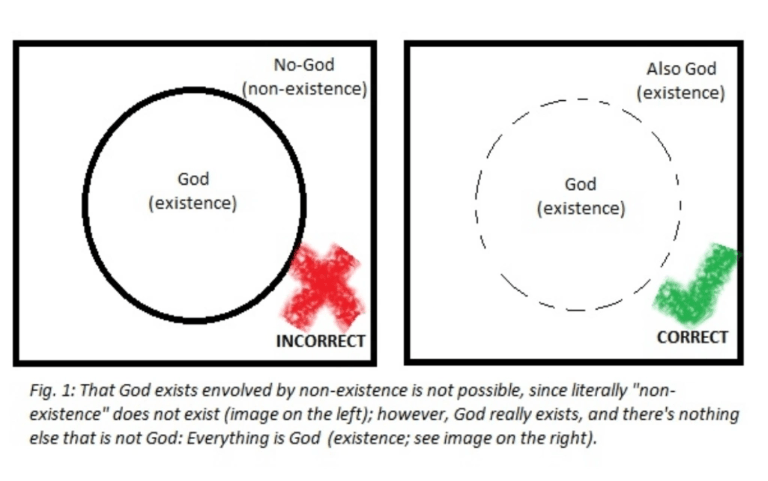
As stated before, Parmenides’s God cannot be refuted by logic. Also, I do not deny that someone could say the opposite though illogical a statement; however, that’d be so by falling into an absurdity, and amounts no more than to an opinion. Someone could also believe this is just a philosophical trick, or a game to keep the mind entertained, or even say that reason and logic are faulty instruments of the mind, and therefore untrustworthy; but all of those are also opinions. In this regard, the fight is between reason and opinion. Which one should we follow? Can we ignore such a logical statement without repercussions? May it be that my reasoning is impaired, just as Parmenides’, and should I suspect of it? What does your reasoning, reader, tell you?
As concluded already, “existence is all there is, and non-existence does not exist.” It is not for us to question why God exists, or why God “decided” to exist instead of non-existing at all. The Truth is that existence already is, eternally; and non-existence does not exist, has never existed, and will never exist, eternally; and we will never know what non-existence is, or looks like, because it does not exist. As per logic, we should refrain from any paths leading into the inquiry of that which does not exist, for this is impossible, absurd, and fruitless.
Yet, it may seem as if we are struck by the disparity of our everyday life where our senses perceive how some things come into being, persist for some time, and then slip into the darkness of death. Because of this seemingly contradiction, Parmenides has been historically contrasted to Heraclitus, who would say that change and impermanence are the fundamental principles of existence.
Heraclitus.
Also known as the obscure, was also a pre-Socratic philosopher and contemporary of Parmenides c. V/VI century BCE. There’s not much known about him, and only fragments of his work are preserved. His philosophy also treated on the nature of existence itself. He says that everything exists in a state of flux, of constant change, just as anyone of us would say after observing the phenomenal world with our senses. Yet, he would go further when he says that though changing, everything remains the same, as expressed in his quote, that “listening not to me but to the logos (principle), it is wise to agree that all things are one.” If by Logos he means logic, in spite of what the senses told him, he would also have to acknowledge that all is but One. Or when he says: “this Kosmos, the same of all, no god nor man did create, but it ever was and is and will be: ever living fire, kindling in measures and being quenched by measures,” which, to me, is the same tenet as in Parmenides’ of the One, uncreated, unperishable, eternal, same Kosmos.
Here is another one, that “all things come into being by conflict of opposites, and the sum of things (the whole) flows like a stream.” So, how can it be reconciled that everything is One but also two? How can the two principles create the existence of the multiplicity of things? This he did not care to explain (or the texts are lost). Parmenides, in turn, also explained the apparent contradiction of our senses as an interplay of dualistic forces. How did he also reach that conclusion, that though One, things “seem” as multiple? This train of thought is also completely missing in his writing. How much did he too, then, use his reason, and what chain of intellectual thought brought him to the final conclusions is not stated.
It is evident, however, that they have more in common. I do not see how their thought contradict the one of the other. Therefore, the enmity imposed between them by history seems unfunded, and simply based on the fact that Parmenides starts with the rational, a priori knowledge of a One Truth, while Heraclitus begins with empirical, a posteriori knowledge of a world in a state of constant change, as it is easily perceived by the senses. How curious it is that one starts with the head (rationalism) and ends in the feet (empiricism), and the other with the feet and ends in the head; sadly, none of them left us an explanation on how to connect the head and the feet together. What is the nature of the phenomenal world, as perceived by the senses, and how its empirical knowledge arrives at the conclusion that everything, as perceived, is One? How is it that everything is One as stated by reason, irrefutable, yet our senses seem to deceive us when we perceive a multiplicity of things, and we easily arrive at the opinion that things come into existence and later cease to exist?
Let me speculate further. Personally, I can grasp Parmenides’ axiom’s logical cohesion and acknowledge it as Truth, although I’m still uncertain of the nature of such a Truth in as much as I don’t know what existence (or God) consists of in its dynamism, nature and meaning. That the world of appearances, or the phenomenal world is in constant flux does not invalidate the axiom, it only gives us a hint on the nature, meaning and dynamism of such existence. Which is to say that we know that existence contains in it the appearance of change; and I also know that such existence cannot cease, nor had a beginning. In this way, I synthetize the two opposites, saving myself from the insanity of thinking that I know what God is (or what God is not), whose nature, meaning and dynamism still remains a secret to me; but I’m content with knowing that “God is,” and that’s as much as I’m allowed to know, saving myself from the insanity of negating its existence in thought which amounts to no more than an absurdity.
What does this make of the preacher that knows what God is, what it wants from us, what is from God or what is not from God if not a fanatic? Likewise, the atheist that denies in thought that “God is not” is just a fool for saying such absurdities. Let whoever insane person be insane in whatever way, there’s room for them all in God, whom cannot be disproven in thought, by thinking that “God is not,” nor in deed, by doing anything that is not God, which is just impossible. The phenomenal world, including the sane and the insane, are equally contained in God, since everything partakes of its existence.
Thus, the window is now open for anyone that wants to inquire more into the nature, meaning and dynamism of God, and into one’s relationship to God, life and existence, and into what is it that is expected from us, collectively and individually. Also, new questions come to mind, and perhaps, by answering them, we could find the missing parts, the body that unites the head with the feet together, as discussed above. Questions like the following should be explored, and see how far can rationalism get before empiricism comes to the rescue: How is it possible that if something exists, it exists eternally, and it cannot be otherwise, but we see that an individual person is born, grows, and then dies? Where did that person go after death? Where did that person come from before birth? Where did a house, or a cup, or a three come from, and what will happen to them after some time? Where did the Universe come from, and where is it going? How can we explain such a contradiction that comes from our senses? Is it possible that our senses deceive us? Is it possible that what we perceive is no more than an illusion?
Aristotle.
We have talked about him before and of his metaphysics. I’m going to skip Socrates and Plato for now, and I will jump straight into Aristotle because it is with him that I can continue my train of thought already in motion.
Let’s summarize the conclusions reached at until now, so that we don’t lose our train of thought. We have said that “God is,” or “existence is,” and that is an irrefutable Truth, in the grounds of logic. We also said that the world outside, as perceived by the senses, imparts in us a different kind of knowledge, an empirical knowledge that comes from the senses, and we know that “things” move. When we see a “thing,” we are not only conscious of the thing that moves and changes, but also of ourselves as the observers. Does that thing, then, exists? Do we exist? If so, in what way?
We have said elsewhere that to exist is to exist eternally, which is to be God. Therefore, when we say that an object, or a person “exists,” as we would say colloquially (like when we say that a flower, a mountain or John exists), we do so out of convention, habit, simplicity, or perhaps because it may be a matter of survival to perceive “things” and label them clearly. Properly speaking, the phenomenal world only “appears to exist” as when we say that something or somebody “exists.” In this sense, the flower that ceased to be a flower and perished, was never properly existing because the “thing” was not God itself who only exists eternally, was never born, and will never perish. To these “things” that undergo change, the whole phenomenal world as perceived by the senses (internal and external) I will assign the term of “manifested existence,” or “God manifested,” as the term seems appropriate, of which change and impermanence is one of its attributes.
Then, are the flower and other external objects an illusion like most religions say? For the time being, whether the external world is an illusion (and does not really exist, only appears to) or a reality (and exists in as much as we perceive it with the senses) does not really matter to us, because what’s important is that it exists in the quality of observable phenomena. Let that phenomena be an illusion if you wish, such an illusion is not a consequence of non-existence (because non-existence does not exist), but of existence (God). Because, for an illusion to occur, something that exists needs must be producing it. So, in that way the external world partakes of God, and is manifested to us, and we are manifested ourselves, through the workings of God, and a product of God, in the quality of observable phenomena.
What is the nature, and the causes of this illusion that seems to exist, yet it doesn’t, and that conventionally we call reality? Here is where Aristotle comes to the rescue. He concludes from his observation of the empirical world (of “things”) that “nothing comes from nothing; since there is something, there must have been some other thing that is its cause.” This, can we grant? Is there any one thing that comes from nothing or not caused by anything? Such a thing cannot be observed. Causeless objects do not exist. We can only say that God/existence is causeless since it is not an object but the source of all objects (internal and external).
For him, what makes some “thing” appear (to exist) is its participation of the four causes: material, formal, efficient and final. Anybody who attentively observes the phenomenal world, such as Heraclitus, or the reader, could have reached to that conclusion. The reasoning goes like this: we have agreed that every “thing” changes (movement), yet what is it that moves or is being moved if not bodies of matter (that resist change), that have a certain form, shape or use, and that such a change is either of the quality or quantity of matter (accidental change) and/or the form, dimensions or use it is to take (substantial change) as time goes by. In such a way, an observer of the phenomenal world arrives at the presence of a material cause (for something needs to be moved), a formal cause (for this something needs to take a certain form in actuality), and a movement cause. This last, Aristotle decomposed in 2: efficient and final cause. If things must need move, let them move efficiently, in what direction, or for what purpose should they move, is according to an agent that wills it in such a way, be it a human or the programming of nature.
It is not my purpose to explain in rigorous detail those four causes, since I think that Aristoteles does it better; however, I will give my own interpretation of the subject. I think the easiest way to explain them is through an example:
Observe the world and take any item. Take for example a cup, the specific cup that you use for your coffee. Why is it said that the cup exists? What does its apparent existence consist of? To which I answer: the cup appears to exists and is “manifested” because it participates of the four causes: a) it is caused by the material it is made out of (glass, ceramic, metal…) as its material cause; b) it is also caused by the form of a cup, by its participation with the idea of “what a cup is,” the “universal cup,” as its formal cause; c) it is caused by the workman’s labor in producing the cup, or the physical, chemical processes that led to the creation-formation of the cup as its efficient cause; d) and it is also caused by its purpose of holding liquids inside, such as coffee, that somebody willed as its final cause. Were not humans that wished cups for the purpose of holding liquids, cups would not exist.
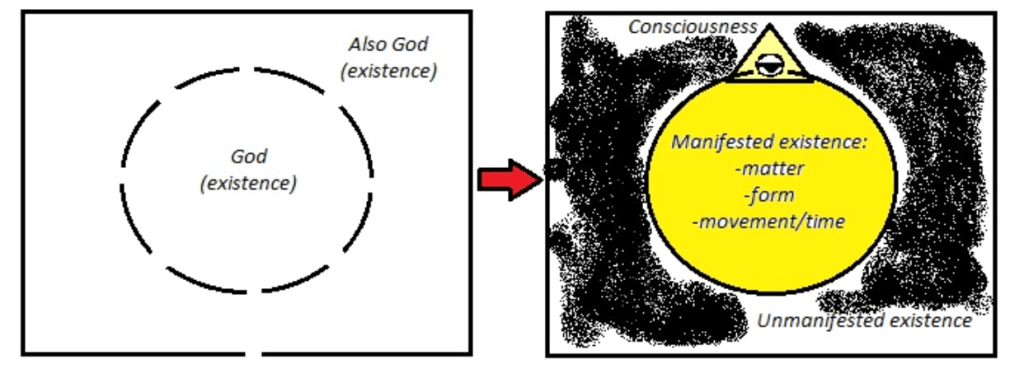
In short, everything that appears to exist and is “manifested”, whether an illusion or not, exists through, and only through its participation with the four causes. The four causes do not exist independently from each other in our “manifested” world of phenomena. Matter is always accompanied by form (also known as essence), and they both are changed from “what it was” towards “what it will be,” creating movement, and with it, the perception of time.
As it all seems to me, all things come from an efficient cause and strive for a meaningful purpose, which in turn would serve as a final cause, the so called “raison d’etre,” in a process that could be called “actualization” in which things that stopped serving their antecedent meaningful goal, but which initially came from efficient mechanical causes (cause and effect, karma, etc.), need to suffer change as they need to take the form of what will fulfill their future new purpose, their new final cause, provided the efficient means to achieve it are in place (otherwise, there would be no change in that direction, though change can occur in a different direction if different purposes are ingrained in a “thing,” of which the one with access to all efficient means will come on top necessarily). Therefore, according to Aristotle, things happen for a reason, including things such as death, sickness, crime, etc., and they serve a purpose. For now, we will be glad to know that there’s a meaningful goal towards which we, humans too, aim at; and human existence, with its ups and downs, beauty, and ugliness, life and death, has not only an efficient cause (the workings of biology, and natural laws, of which we do not comprehend completely), but also a meaningful “raison d’etre” for our individual and collective existence toward which we are constantly actualizing ourselves, a sort of “will to meaning” as introduced by the famous psychologist Viktor Frankl. As to what that meaningful goal for us individually or collectively is, we will discuss it later.
Aristotle would also propose an axiom that resembles Parmenides’. It is the following one: “It is impossible for anything at the same time to be and not to be.” In my own words, I would rephrase it thus: “it is impossible for any one thing at the same time to appear to be and not to appear to be.” I would ask anybody to refute such a statement. In the same way, no one can say that “something can be a thing, and not be that same thing at the same moment in time” without falling into an absurdity. The best way to explain this statement, and the four causes is through an image:
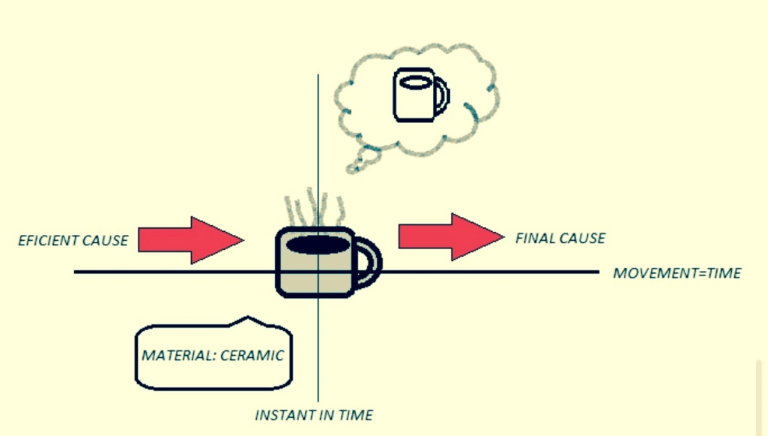
To “things,” objects, that union between form and matter he would call a “substance,” defined as that thing-ness which survives accidental change, or change of locality, by virtue of it retaining its form, or essence, and therefore it is a “thing in itself,” in its individual-ness for a certain extended period of time in which it fulfills its purpose. It is also this substance what exists (or appears to exist), and cannot not exist (or not appear to exist). In our example, the individual cup retains its substantiality, its apparent existence as that specific cup, and cannot not (appear to) be that specific cup at the same instant in time, and (appear to) be something else, let’s say, a plate.
Note that we are not considering the movement of objects in space, which is also change. For now, Aristotle’s analysis consists in freezing time to an instant, and studies phenomena by comparing two separate instants in time. If a cup looks like the very same cup after some time, that cup is said to have not changed, by virtue of retaining its form as a cup, even though the particles of matter vibrate, and move, or its dimensions changed in a way that was imperceptible by the senses, not taking into account if the cup was in Europe at first, and now it is in China.
It is said that a change is “accidental” when, by virtue of more or less retaining its form, or essence, a substance (object) perseveres throughout time. Therefore, the change – for change must always occur – has to be “accidental” in the distribution, quantity, and quality of its matter particles. For example, the cup will still (appear to) be the very same cup if the change was in its color, weight, or size while still retaining, more or less, its initial cup-form. It is said that a change is “substantial” when there’s a “trans-formation” from one form into another or in other words, when something loses its essence and takes the form (or essence) of something else, as it necessarily should, because matter cannot exist by itself without form (and be perceived at the same time); it must take the form of something else. (The pair mass/energy cannot be destroyed, only “trans-formed!”). An example could be the cup morphing into a pile of broken ceramic chips. The individual cup ended its “apparent” existence as a cup, and became a pile of broken pieces of ceramic. Also, before being (apparently) a cup, it was (apparently) a bunch of clay. So where did the cup go after being destroyed? And where did it come from before being made? Where did his essence come from and where would it go?
How can change be explained? Aristotle says that beings undergo change because they have in themselves the potentiality of being something else ingrained in their own existence. So, a being “is” (or appears to be) in actuality such a substance, but it has inherent in itself the potentiality of becoming a different being, a different substance. So, a being is that which it is now (apparently) in actuality, and that which it can potentially be (apparently), at the same time. In other words, substantial change happens when things undergo metamorphosis from (apparently) being in potency, to being in act, interchangeably. He does not directly explain what relationship there is between movement and (apparently) existing in act or potency with the other two causes: efficient, and final cause.
Personally, I do not see why they cannot be grouped into one principle or cause: movement which is both efficient and meaningful. The efficient cause being that which was potentiality in the past (actual clay with the potential of being a cup, a plate, a vessel, etc.), that got actualized in the present moment (as a ceramic cup) to fulfill its final cause (of holding hot liquids), and now has a new set of potentialities that can be fulfilled, if the new efficient means are available to bring in a new change into a new actuality (like becoming broken chips), based on its new final cause, or purpose in undergoing new change.
To conclude, from the attentive observation of the phenomenal world, we can agree with Heraclitus that everything is change, and all things are impermanent. Also, as Aristotle observed, we can also agree that everything that appears to exist is in constant change and participates of the four causes, at all time-screenshots, that is, at all instants. In fact, the four causes are everywhere, every time, and in that sense, they are eternal. Matter, Form and Movement are eternal causes which combine in multiple, perhaps infinite ways for us, the observers. Given that Aristotle dissects reality by fixating it in an instant where Movement is frozen, he divides the continuum of movement into past and future, into efficient and final cause respectively.
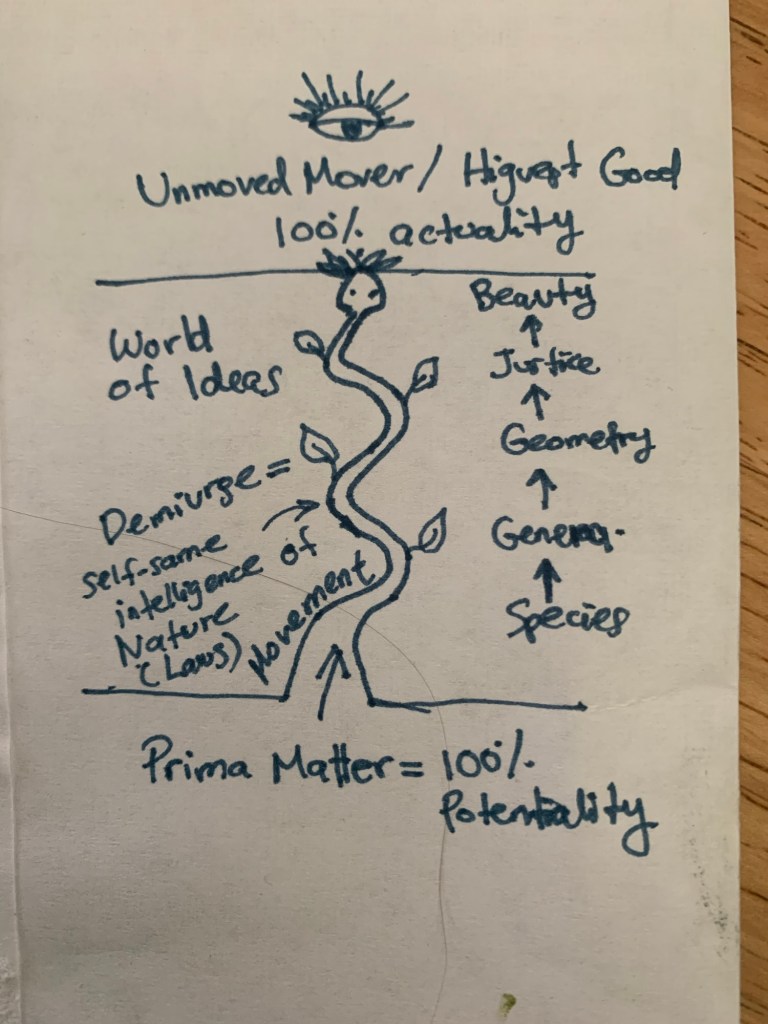
Next, it is my interest to describe the concept of the “Unmoved Mover,” Aristotle’s idea of God! The reasoning goes like this: because things move from potentiality into actuality, and to avoid an infinite succession of causes, there must exist some agent that is not a “thing” which moves all else (otherwise it would itself be moved). From this we can deduct that this agent is immaterial, and the most final of the final causes, being fully actualized for eternity. The movement of things that move is, then, an aspiration towards this final of causes.
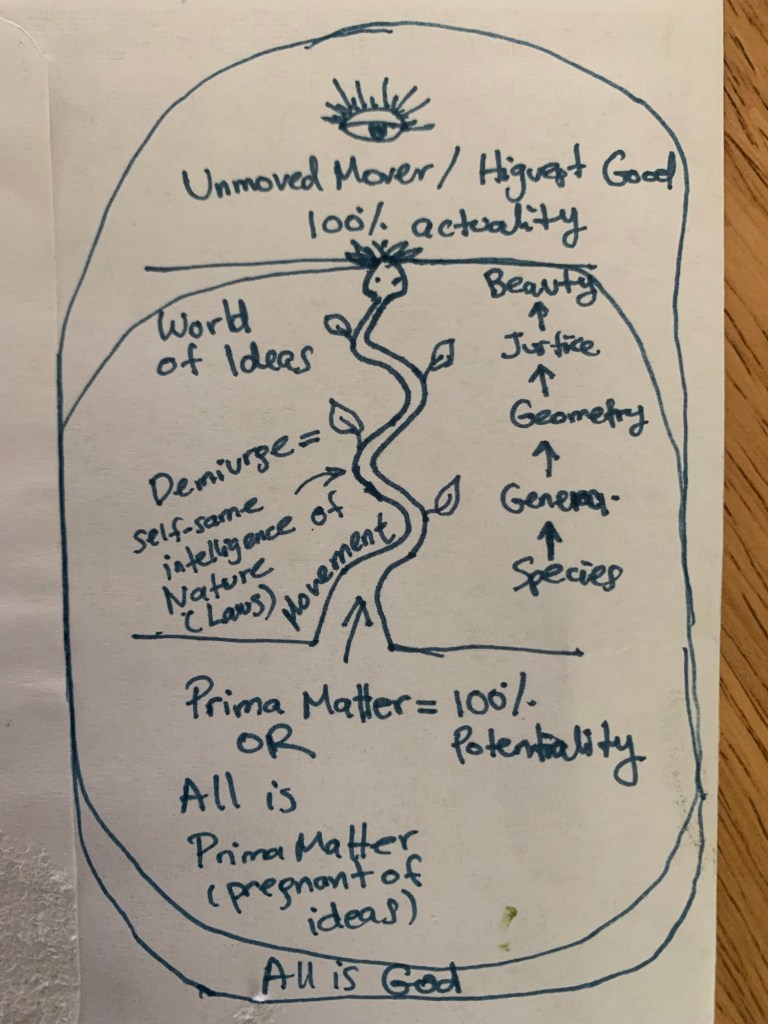
Interestingly enough, he classifies this agent, this Unmoved Mover, as a final cause (the ultimate object of desire), and not as a efficient cause. The argument can also be made, then, about a principle who is pure potentiality and has undergone zero actuality. Such a principle would be the most efficient of efficient causes, something akin to the concept of “formless matter” or what the alchemist referred to as materia prima (prime matter). This concept was later developed by future philosophers, but Aristotle himself did not explain directly. Both Unmoved Mover and Prima Matter are formless. The first because it lacks matter who can only take forms, and the latter because is has yet to take a form, or because it refers to the underlying matter of all objects once we discount their form. These two principles transcend Movement, therefore, cannot be perceived by any sense, only be inferred. Are these two the opposites referred to by both Parmenides and Heraclitus?
There are a few more questions for us to ask: what is the finality of all things that exist manifested? What is their “raison d’etre”? What is the final cause, or ultimate purpose of everything that moves? Wouldn’t it be logical that as soon as there are no more final causes, then, movement should cease? But we just said that Movement is eternal. But, does this mean it is eternal with a beginning but no end, or with neither a beginning nor end? Was there ever a moment where Prima Matter existed (properly speaking, since it is an eternal principle) by itself without taking any forms, therefore, without any movement taking place? Wouldn’t Movement, which is also an eternal principle, also imply rest (as caused by inertia), only to begin anew, provided the aspiration towards a goal is present to fuel the whole mechanism of movement again?
These questions, we will leave unanswered, for now.
Plato.
I think that Plato is to Form, what Aristotle is to Movement. Plato would separate the Universe in two differentiated parts: the world of Matter versus the world of Ideas. For him, substances (or objects) in the material world exist in as much as they participate of the Ideas that shape them, and in this sense, Ideas are eternal. However, it is our view that the phenomenal world, although it participates of Ideas, these Ideas in their purest form cannot be replicated in “real” life. These Ideas can only exist in our minds. For Plato, Goodness itself was the ultimate form for which every other form, or Idea, derived its goodness and existence. He also talked about a Demiurge, the “craftsman” who gave shape to the material universe by molding Matter (which Plato probably also believed to be eternal) after the pattern of forms. In this sense, the Demiurge was subordinate to the realm of Ideas since it needed to be in close proximity to matter. Throughout history, Goodness as an Idea, or the Highest Goodness has been equated to God. Plato’s Idea of the Good was then rolled over into Christian ideas of God.
We have described, in short, in what Plato’s philosophy consists of. Personally, this Idea of God as the Highest Goodness towards which all objects aspire to does not deviate too much from Aristotle’s Unmoved Mover. In fact, I could venture to say that they are one and the same. Again, the historical enmity between these two seems unfounded.
Let us speculate further. We have said so far that there’s pure potentiality in Prima Matter which aspires towards Unmoved Mover (or Highest Idea of the Good). What is left in between is the phenomenal world that is to take different forms in order to approximate to its goal or even fulfil its purpose (whether this can be achieved, we will discuss later). What we have is then objects, the phenomenal world of appearances. In the same way we deduced Prima Matter as “formless matter,” full of potentiality; in the same way, we can ask ourselves whether these forms can exist without matter. Ideas just as the idea of Justice, Beauty, geometrical figures, numbers, the chair-ness of a chair and of all chairs, the human-ness of a human and of all humans, etc., are the stepping stones towards the Highest Good (ideas are of a higher or a lower order, according to Plato, based on their approximation to the Highest Good). These Ideas are none other than all the potentialities initially assumed existent in Prima Matter. In that sense, Ideas are, indeed, eternal. The question that remains is the order in which these Ideas need to succeed each other, why 2 comes after 1, and not after 3 or 0, or why there needs to be animal life before human life, or why are there not objects taking whatever shapes or forms randomly, but we have an efficient (and also meaningful) Universe?
Plato’s answer is, of course, the Demiurge, a sort of agent that “wills” the Universe to be in such and such a way, and not in any other way. For example, let’s imagine a Universe that consists in its entirety of an on/off switch. There are no planets, no humans, no diversity. Only a switch perceived by an all-pervasive consciousness that witnesses this switch going on and off, eternally. Sometimes, the “on” position stays longer compared to the off position, or sometimes is the other way around, or perhaps, there will be times when they both last equal times. It could also occur that the switch only moved once, but for whatever reasons, it did not switch to the opposite ever. Still, this Universe (lame as it can be), would nevertheless consists of eternal movement (and rest), it would participate of some kind of material making up the switch and of the idea of switch-ness, making of it perceivable by a consciousness. Likewise, let us consider another example, that of a Universe consisting of a never-ending simulation of a ping-pong videogame, where the ball bounces at every contact with the four walls that contain it. This Universe would also be eternal, a perfect perpetuum mobile. So, the question seems to be, why is the Universe we perceive existing in such a way, and not in any other way? Why are there Laws that rule over movement? Why is movement efficient (in as much as it follows certain Laws) and not chaotic or random? Why is movement final, aiming at the Highest Good, and not meaningless (or aimless), like the switch, or the ping-pong, Universe? Can we really say there’s an aim at which the Universe strives for?
We will leave this questions unanswered. Perhaps it is not for us to question why the Universe is the way it is (or appears to be), and not any other way. All that we can do is observe the Universe as it is, and infer its characteristics. What has been inferred, so far, is that movement is efficient, following certain Laws, for the sake of some certain Higher Good towards which it aims at. This aiming, however, if it is true it exists (and how can anyone say it does not, for aren’t all things, animate or inanimate, moved by attractions, forces and desires? That is to say, aren’t all things moved by a force, internal or external, or really both internal and external, of a specific magnitude and direction?), had to be (or appear to be) willed by an intelligent agent which Plato refers to as the Demiurge. It is by the will of the Demiurge that the Universe is what we have, with the Laws that we have, and such a will is still the same, so the laws remain the same, but the world keeps its course in a way that seems efficient in as much as the way things are is still meaningful, and is still willed in the same way. This Demiurge, however, is both immaterial and formless. It belongs to a different category or principle. It is simply Movement that has a logic of its own. Interchangeably, we can refer to it as the Law or Intelligence that moves matter into different forms for the sake of approximation to the Highest Good/Unmoved Mover. Movement cannot simply be any movement, it has to be both efficient and purposeful, achieving its end despite the inertia caused by mater. Perhaps we can discuss this topic as we continue with this essay.
To conclude, what we have concluded simply by studying the ancient Greek philosophers is represented in the following images:
Saint Augustine.
Platonic ideas shaped Christian thought. According to Augustine, everything is inherently good, because God created it, even when things are seemingly evil. Evil, for him, does not exist in the absolute sense, but appears to exist, as a result of people not being fully conscious of God’s Beauty. In this way, what appears to be bad, or evil to us, is simply a privation or turning away from the Highest Good (which is God). Put in absolute terms, evil is ultimately good because it exists as a part of the Whole, and has its raison d’etre, which is to be used as a source of good, therefore, it is only temporary. It can be used as a mean towards an end. For now, enough of Augustine.
Saint Thomas Aquinas.
Christianity also borrowed from Aristotle some of his ideas, and Aquinas lays down his view on God that shaped the Christian world in the Middle Ages based on a First Mover, just like Aristotle’s Unmoved Mover. He also said that we can know that “God is,” since His role is pure existence, pure actuality, but we cannot know what He is, and we should content ourselves with knowing what God is not. This, we do by studying its effects (the phenomenal world), which, following the Logos, the idea of God can be inferred. Let us move on. However, Aquinas would argue that the First Mover is also an efficient cause, that is, initiating movement. He is, then, assuming that this Universe had a beginning, and that it was created from “nothing.” This, we cannot grant, unless he is referring to unformed matter which, first and foremost, needs to find the efficient means to its final end, that is, establish what Laws of Nature will regulate its movement. This First Mover, originated from the Unmoved Mover, is, to us, none other than the Demiurge. So, if things have a beginning, at a moment Prima Matter existed in itself, and they also have an end, as when the manifested Universe fulfills its end, then, movement would be cyclical (a Universe that is born, grows and is destroyed, only to, perhaps, recur again). Let us leave this speculations for a later time. Enough of the Middle Ages.
Descartes.
He is one of the most important philosophers on rationalism. He is famous for the phrase “I think, therefore I am.” So, basically, he urged us to doubt from everything and create a philosophies as if for the first time. He proposed himself to prove, first and foremost, that something could be said as existing, while being skeptical about the senses and of men’s opinions. He concluded that if he doubted, something, or somebody, should be doing the doubting, and that proves that “he exists” as a self-evident axiom (to him).
Personally, I think that the Descartes “I think, therefore I am” is a little tricky, and may be misguiding to some. Let me, in turn, mistrust his authority and his conclusions. His argument is this: he, being aware of himself as a doubting entity, and in virtue of that activity of thinking, he concludes that “he exists.” But does he really exist? What is that “I” that he assumes as existent? Is that “I” the cause of the “thinking”, or is it something else? How is he sure that the thinking is done by the “I”? I would still remain skeptical, for the time being, given that his concept of “I” is not clearly defined. Granted, there’s thinking, but does that justify the “I”? The only conclusion that I can draw is this, that “there’s thinking; therefore, there’s must be something that exists (even if all were illusory, appearing to exist, there must be something ‘real’ existing generating it), and by deduction, existence is all there is, since non-existence does not exist” (as we remember from Parmenides). Here, we arrive also at something different, not to the “I” that appropriates phenomena (the flux of thoughts), but to consciousness in itself, consciousness qua consciousness.
Let me elaborate further. One is, at best, conscious, aware of thinking as it happens, and since there’s something of which one is aware of, we can, at best, make the distinction between the consciousness that observes and “things” of which the “I” seems to be conscious of (but the “I” is also a “thing,” hence impermanent). There is a difference between consciousness and observable phenomena, or between perception and the perceived. In a broader sense, thoughts are nothing more than observable phenomena, just as external phenomena, objects, as perceived by the senses, and I would venture to add feelings, dreams, visions, etc., into the mix. In conclusion, the important thing is that there’s consciousness, the observer, and observable phenomena, whether external or internal (from our apparent bodies), of which all, including our sense-perceptions and feelings are just representations in the form of thoughts, and reach the observer-consciousness in that way to be observed.
If Descartes refers to an existing “I” that is equivalent to his body, or his identification with the thinking, I will have to disagree with him, since he’s referring to the ego that, just like all observable phenomena, is impermanent, and therefore does not exist properly, but appears to exist. Just like the rest of the observable phenomena, the ego (body and identification with the thinking) also moves, participates of the 4 causes, was created and will be destroyed efficiently and meaningfully, consists of a body of matter of a certain shape to which we attribute the Idea of “I-ness,” and only differs from the rest of the observable phenomena by a 5th principle (should we call it cause?): a consciousness that can observe and grasp the phenomenal, impermanent world via thinking, whether the thinking is simple or complex. From Descartes I would conclude that “consciousness exists,” and I don’t see how could anybody refute it. If the “I” exists, just as Descartes says, I cannot but question what happens when he, or anyone, does not think, like when one sleeps, or is in a comma? What happens when one meditates, or is intoxicated, or reaches states of consciousness in which the “I” appears to be no more? Granted, when we die, we lose consciousness, and we cease to exists as “I,” but then, that “I” only “appears to exist,” and does not exist properly, as we discussed earlier. Such an “I,” if not eternal, but impermanent, cannot exist, but appears to exist in as much as that consciousness identifies with that “I,” which participates of the 4 causes, in what way I cannot tell exactly, but I suspect that through thinking by hyper focusing on a part of the phenomenal world, that in this case is a body, and the contents of the mind. I would refine my own axiom via Descartes-Parmenides: “There’s thinking, therefore God is;” and “through consciousness, I know that God is,” but “without consciousness, though God is, I wouldn’t be able to know it.”
We can also speculate further and ask ourselves whether consciousness is necessary, and whether there would be something that exists if there’s nothing that perceives such existence. Imagine there’s no life, or no consciousness in the Universe, and though it exists, it would be as if it didn’t because there’s no consciousness to observe it. We wouldn’t be able to think either, or to know, and Parmenides would’ve never happened, and his axiom would’ve never been able to be proved rightfully, and non-existence would’ve been as valid as existence, but given that we have consciousness that proves existence and that “God is,” I would have to include Consciousness as another inseparable principle of God together with Matter, Form and Movement. Wherever we direct consciousness, either outside, or inside ourselves, we encounter observable phenomena (whether we identify with it, the ego, or not), and such an act of observation proves that something exists, and ultimately that “God is.”
In what way is Consciousness a principle could be speculated. Consciousness is inseparable and is evidently different from the 4 causes. It also exists without regards to place, and it only creates the perception of time because it observes Movement. Is it eternal? Perhaps. Does it cease to exist when we die? Who knows. So far, we can say that what ceases to exist is the identification or hyper focusing of consciousness to our body-mind complex, the “I-ness.” Can it exist separated from the 4 causes? Maybe. It seems like the 4 causes can, in turn, exist separated from consciousness (at least my own consciousness), since there might be places or times that are outside of my range of consciousness, but for that reason I cannot say that they do not exist, though to me it is as if they don’t. Though there might be a higher consciousness that’s responsible for the creation of the phenomenal world, and in what way my own consciousness participates with that Higher Consciousness is another mere speculation. Could it be that this consciousness is none other than the Unmoved Mover or the Highest Good? This would not be so disparate. After all, consciousness fulfills the qualities of immateriality, lack of form or attributes, and, why not?, eternality. But, this, for now, is but speculation. However, that would make of we, humans, the most proximate creation to it, and the ultimate achievement of creation or evolution (that cannot ever be pure actuality, but always becoming). Our “idea of consciousness” being simply that, an idea, a reflection, is proximate enough to consciousness itself, in its purity, which cannot really be comprehended by the mind, since it is the source of the mind. Consciousness would transcend the phenomenal world, which, to me, is the same as the Unmoved Mover that attracts, or the Highest Good at which all things aim at.
Let’s continue. Descartes is of the idea that we are born with innate ideas and that the very same idea of a God that is perfect and infinite (associated with the Ideas of Perfection and Infiniteness), which Idea could not possibly come from manifested phenomena by the senses, and that must come from somewhere else is enough proof of its existence, given that no thing comes from “nothingness,” and that Idea of God and its Perfection comes from God Himself.
(We will leave this reasoning aside, and perhaps discuss it when we discuss Locke and others that oppose the existence of innate Ideas. I think that whether God, Perfection or Infiniteness are innate or are a result of our experience, we cannot deny that we have those Ideas, though we could not possibly be able to represent them or grasp them fully with the mind.)
However, Descartes proposes a God that is an active, efficient cause who created matter and its motion, and continues to sustain that motion through laws of physics. This, however, we cannot grant, for we have said earlier that Matter and Movement are uncreated, but what can be created are the different Forms that Matter will take as objects of perception. This efficient cause is none other than the Laws of a Demiurge. Descartes’ god is a Demiurge.
Baruch Spinoza.
Another important rationalist who would say that there is only one Substance: God or Nature. For him, the natural universe in its entirety consists of God as a Substance, and in such a way, God is only truly substance because it is the Whole, and therefore Perfect; and everything else which is but a part of the Whole, and not Substance, he would call a mode, and that includes attributes and individual things, such as humans. Spinoza’s system would be called pantheism.
When I study Spinoza, I encounter certain conclusions that we have arrived at so far, like “no cause or reason” could prevent God’s existence, and therefore it must exist; or that “whatever is, is in God, and nothing can exist or be conceived without God.” He states that God is “the sum of the natural and physical laws of the universe, and certainly not an individual entity or creator.” The last proposition could be debatable, but so far so good. He states that things “could have not been produced by God in any other way, or in any other order than is the case,” and it may be argued that there’s little room for free will in Spinoza’s thought. There’s also little room for teleological reasons, or final causes for anything to exist. Given that only God is Substance proper, and only God exists as a Totality, any lesser parts are necessarily imperfect, incomplete, and the most we can aim at is to a clear understanding of our condition as imperfect and in a certain relationship with everything else in the universe. That can also be granted.
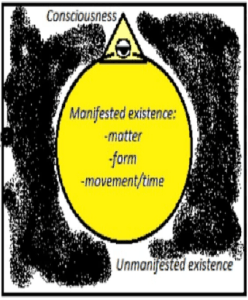
Here is my take: Am I, perhaps, a pantheist? Yes, most likely. When I say that “God is,” I’m referring to the totality of existence, just as Heraclitus referred to the Kosmos as a Totality, a Whole of all existence. I would agree with Spinoza’s Universe if he refers to everything that exists, whether we perceive it with the senses, or not. If he refers to the “material” universe, or the manifested world of phenomena as perceived by the senses only, the universe about which the scientists of today say that started with the Big Bang, and that will perish from a Big Crunch, Big Freeze or a Big Rip, in other words, a universe that had a beginning and will have an end, then I would disagree with him. When I speak about existence, I’m referring to a Totality that includes the manifested universe as perceived by the senses, and the unmanifested universe that is not perceived by the senses, such as the fundamental principles or causes. And if it happened that there was a Big Bang, it could have not possibly come from nothingness, since nothingness does not exist; and if the universe will perish one day, it won’t sink into nothingness for the very same reason. As I see it, the manifested part of existence, the universe, came from unmanifested existence, and will sink into it (if it is true it may sink some day). That very absence of a manifested universe as the result of the destruction of the manifested universe is, most likely the only condition, or one of the conditions for a Big Bang to happen; so, the possibility of another manifested universe, perhaps exactly the same as ours, or perhaps different, after another Big Bang in a cycle ad infinitum cannot be ruled out. As far as I can tell, Movement implies change and impermanence, and there’s no impermanence if we don’t allow things to die, including the manifested universe that needs to sink into non-manifestation so that new manifestation occurs. In what way, I cannot tell. Let’s not forget that for a part of existence to be manifested, it should have the capacity to be observed by a Consciousness that focuses on it, whether that consciousness is present or not. If there is no Consciousness that could possibly observe any part of existence, then such part of existence is unmanifested, and appears as non-existent compared to the part that can be observed by Consciousness, though it still exists but unmanifested. Let us see the following image:
In regards to consciousness, I cannot be certain in assuming that other people, like me, have consciousness, or that there’s a Higher Consciousness responsible for the entire manifestation, because I can only be certain of my own Consciousness. However, if we make that assumption, that there is more than one consciousness, other consciousness other than mine, and such consciousness would be conscious of different things than I am, then, I don’t see why not assuming that the whole of “manifested existence,” of which there are parts I myself am not conscious about, is being manifested to some other consciousness, a universal consciousness, perhaps? Is my consciousness part of such hypothetical universal consciousness, and contributes to it, or is it different and independent? I don’t see how these questions can be solved, just as I cannot ever be certain that Jupiter, for example, exists truly other than just the stories, photos, and opinions of what seems to be people, but that could very well be just automatons without consciousness, tell me about Jupiter. In what way can I prove other people’s consciousness, or that there is a Higher Consciousness, or in what way I can broaden the focus of my own consciousness I cannot tell. These is an argument I will present: when I observe my “idea of consciousness,” I cannot imagine a consciousness that is limited, by time or space, therefore it must be eternal. What I can imagine, and, perhaps, actually see occur, is a consciousness that is focalized, in this case, into the mind-body complex. In that sense, all (seemingly) individual consciousness are really just One single consciousness that has hyper-focused (or just focused) onto different mind-body complexes. If, in true, this consciousness is just one, it cannot be other than the Unmoved Mover or the Highest Good.
I agree in that the “I-ness”, impermanent and in quality of a part immersed in the Whole can never be the Whole, but participate in relationships with everything else within the entire system, of which it is a part, and therefore, necessary, and without it, the Whole could not be a Whole. I hadn’t talked about it, but the knowledge that “God is” brings with it the matter of my relationship toward God, in what way I set myself to know God, and in what way I behave in respect to the Whole which is God. What is the relationship between the “I-ness,” or ego, to God, or the Totality of everything that is? In what does free will consist of, if I cannot do other than what God pre-determined things to happen? We will discuss such topics another time.
Wilhem Leibniz.
Together with Spinoza and Descartes, he is the third of the most influential rationalists of his time. I’m going to skip much of his ideas on God, given that they resemble some of the postulates we had expressed already. He states that “souls act according to the laws of final causes, through aspirations, ends and means. Bodies act according to the laws of efficient causes, i.e. the laws of motion. And these two realms, that of efficient causes and that of final causes, harmonize with one another.” I cannot do otherwise than agree, given that the phenomenal world perceived by the senses consists of both efficient and final causes that meet in the instant of time. Even when bodies move effectively, that is, mechanistically determined, they do so by following a pre-existing will (of the Demiurge) that set the Laws of Nature, whose ultimate purpose, it seems to me, is a process of evolution that climaxes with us, humans. We could venture to say that the purpose of manifested Universe is the maintenance of life, especially human life. But we humans can, now, exercise the instrument of free will and aspire towards one definite thing, disregarding other things. Then, just as Augustine or Aquinas would say, evil is wrong cognition and willing; whereas goodness is rejection of evil by willing to know God. Leibnitz would famously claim that this world is “the best of all possible worlds,” the optimal Universe, provided the limitations of Matter. Evil, then, is a by-product that God allows, and it may be instrumental to achieve the ultimate goal of phenomenal existence, that is, the closest approximation to consciousness, the Unmoved Mover.
Why have inquired elsewhere why this Universe is not just a switch or a ping-pong simulation, or any other simulation, a Tetris game for example. Why did it have to be the way it is. This would require deeper studies, but Leibnitz starts to make sense when he says that this Universe is the most optimal creation that balances maximum variety (potentialities) with maximum simplicity (one actuality). Evil, then, no matter how evil, then, is a necessary by-product, therefore it is ultimately good.
David Hume.
Empiricist. He did not believe in innate ideas and says that all ideas we have come from experience. He believed that causality and inductive reasoning cannot be justified rationally, and they result from custom and mental habit: “Experience cannot establish a necessary connection between cause and effect, because we can imagine without contradiction a case where the cause does not produce its usual effect…the reason why we mistakenly infer that there is something in the cause that necessarily produces its effect is because our past experiences have habituated us to think in this way”. Also, that “only in the pure realm of ideas, logic, and mathematics, not contingent on the direct sense awareness of reality, [can] causation safely…be applied—all other sciences are reduced to probability.” This questioning, we can understand. However, we have said that we can argue there are Laws that have been willed. Were there no laws of nature, or where there true that the ultimate finality cannot be reached, then, this Universe may as well be a switch with no meaning at all. We could, at most, doubt the capacity of a Universe to achieve its ultimate end. Such a Universe would be nothing but an error. This rules-based Universe is contingent upon proven otherwise. Can this be proved?
He would also say that the “real” world is that whose impressions are the strongest, just like a “real” hot pan would impress the mind with “pain” as an idea very much strongly than recollecting the “hotness” of a pan from memory. I would have to agree with him on this one, but with some exceptions. I would say that most people, and most times, sensing impresses the mind stronger, but there are times where sensing goes unconscious, like when we are asleep, or during a hallucination, where the contents of a symbolic nature that are full of feeling impress the mind strongly. Just think about a St. Paul having some of his Apocalyptic visions. To him, the visions where as “real,” or even more so than external “reality.” Perhaps he would require a “real” hot pan to bring him back to “reality,” but perhaps not even that. Then, what is “real” or what is not, if not something very subjective? I would venture into saying, again, that we have consciousness, and we can observe phenomena, whether that is through sensing, thinking, recollecting from memory, dreaming, feeling, etc. In what way do we choose what to focus our consciousness on, or not, I cannot tell. In what way does “free-will” consists of if not in that focusing of consciousness that “identifies” with the contents of the mind and the physical body, aka. the ego?
Hume would say that deterministic views shouldn’t be opposed to the notions on freedom, since the debate has taken millennia due to ambiguities in terminology. He defines freedom as “a power of acting or not acting, according to the determinations of the will.” Then, he would say that they both, necessity and freedom, are connected in that sense, since we can only do that which we will (or aspire to) as long as the efficient means are present, necessitating them. This is a softer determinism, or what has been referred to by others as alternativism. This, we can grant. But how this last view cojoin with the idea that there’s no necessary underlying cause-effect relationship or laws ruling the Universe, I can’t tell.
Speculations about God.
Let me venture myself to formulate my own speculations concerning God, its dynamism, nature and meaning. In that way, let me also honor the attitude everybody, or almost everybody, had in doubting authority, other men’s opinions. There are many more philosophers, theologians and thinkers that I could’ve cited, yet, I’m of the idea that most of what could’ve been said had been said with the few samples from above.
The problem, the very same problem about the existence of God (the existence of existence?) is the very same that has been discussed as an interplay between Parmenides-Heraclitus, and who knows if these two apparent opposing lines of thought hadn’t been arrived at previously in history. Let’s try then, to attempt my own synthesis and arrive at my own hypothesis/speculations. Here I go.
I can clearly see, deduced from an “a priori” knowledge that comes from the use of reason that “God is” and, perhaps an “a posteriori” knowledge that comes from experience, that “there’s Consciousness, and a phenomenal world of which to be conscious about; therefore, God is.” In this way, reason and experience meet to complement each other. Reason cannot be “reasoned” in the first place if there’s no Consciousness that is aware of the workings of reason and thinking, as phenomena of the mind. Were there Consciousness alone, but not something at which to be conscious about, there wouldn’t be anything that exists, and the idea is absurd because “God is” and “Consciousness, together with phenomena, is” already and cannot be refuted. Were there phenomena, aka. things that exist, but not a Consciousness that observes it, it would seem as if nothing exists, though something really exists but unmanifested, unconscious. Without Consciousness, could there be change? The Kosmos would be absolutely immersed in darkness, and under what laws, what dynamics, what nature, it would be impossible to know because there’s no knower. Yet, there’s Consciousness, and my very same consciousness is proof enough of its existence, and I find such consciousness an indivisible principle of what constitutes the Kosmos or God.
The manifested existence of things that seem to exist could not be possible without its capacity to be observed by a Consciousness. I’m going to say that manifested existence is manifested, whether my individual consciousness is present there in space and time or it is not, when it has the capacity to appear manifested to my individual consciousness if it happens that my individual consciousness is present there in space and time. For example, Pluto may be assumed to exists manifested, despite my consciousness not being present in the confines of our planetary system, but if it happens that I travel to a place where I can perceive Pluto with my very senses, then Pluto will be perceived by my consciousness. Another example, my room, though I’m not in it right now, seems to exist continuously according to some laws when I return to it and perceive it again with my senses, and I say that it is manifested because it has the capacity of being perceived, whether it is being perceived at the moment or not. Manifested existence is manifested because it can be observed by a consciousness, whether that consciousness is present there in space and time or not. Unmanifested existence is unmanifested because there’s no consciousness that can possibly observe it, and therefore it is outside space and time, though its existence could be inferred by deduction.
What could be the limits of what is manifested versus unmanifested? Through our studies of manifested phenomena, we discovered that there’s change and it consists of Matter, Movement and Form. Those 3 are also principles of Nature, or God, and are never presented to us separate, but combined among themselves. There is no Movement if there’s not a multiplicity of Forms that Matter could take.
We also deduced the existence of an Unmoved Mover, a Higher Good, and Matter qua Matter, or formless matter. None of those could be grasped by any consciousness, only deduced from inference. We have the following:
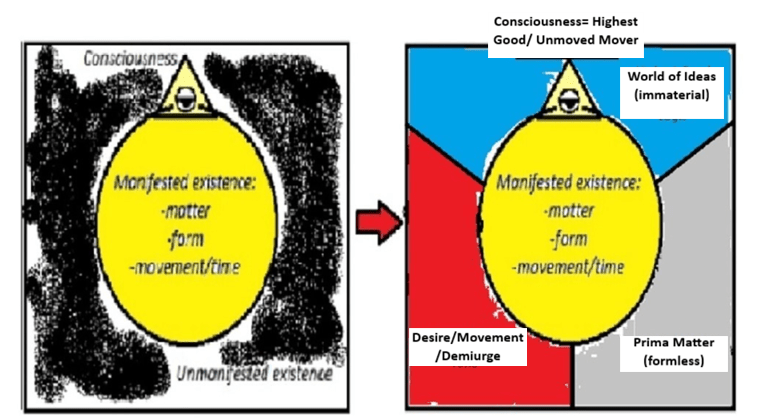
We assume that movement is efficient out of habit after observing the phenomenal world, yet there’s nothing that proves that the natural laws that worked until now will continue working indefinitely, just as we cannot be sure that manifested existence would remain manifested and congruent from one instant to the other, and let’s say, the sky falls apart, or the universe disintegrates out of mere caprice with no warning whatsoever. But so far, things seem to move in predetermined ways or laws in a way that is congruent with the past, and therefore we say that things have an efficient cause. This assessment is contingent, a’la Hume, until proven otherwise.
We also assume the existence of final causes that are meaningful in as much as things serve a purpose, whether that purpose is “willed” by Nature or it is a purpose “willed” by humans to serve their needs (material or spiritual). For things to serve a specific purpose they need to change into a specific new form to fulfill it. In what way does clay become a cup if not because a human “willed” it for the purpose of holding liquids? In what way does a seed become a tree if it didn’t have that set of instructions ingrained in it for whatever purpose Nature had for it, aka., the perpetuation and maintenance of life? In what way do particles of dust become planets and galaxies, or the entire manifestation of existence if not for the purpose to be observable by a consciousness? In what way is movement efficient, as it may not have to be, and in what way were those laws “willed” if not by a specific purpose to maintain a congruent universe that could later maintain life and consciousness? In this sense, the entirety of manifested existence seems to exist for the purpose of maintaining life, and ultimately, being observable by a consciousness.
Let me elaborate further. Movement is either infinite, with no beginning nor end, infinite with a beginning but no end, or finite with a beginning and an end. I will have to say that it can be either way, depending on how you see it. I will say that it is infinite with no beginning nor end, but it appears as if it has a beginning, and possibly an end. Why so? Because one of the attributes of existence manifested is Movement, and although there are parts of existence that are not Movement, like Matter or Form, none of them are manifested without Movement. One of the characteristics of Movement or change, ingrained in its definition, is impermanence, that of existing manifested and sinking into un-manifestation, whether those are individual “things,” humans or the observable universe as such. If we are to believe that the observable universe has a beginning, which modern science calls the Big Bang, it is in the quality of a First Mover, a Demiurge setting the Laws of Nature. If we focus on that instant, before any efficacy in Movement, and before any laws that could be corroborated, the First Mover had to “will” meaningfully, and for a purpose, a first Movement that would bring into manifestation what was unmanifested in as much as it now has a quality of being observable by a Consciousness (whether there was a consciousness present, or not). See the following image:
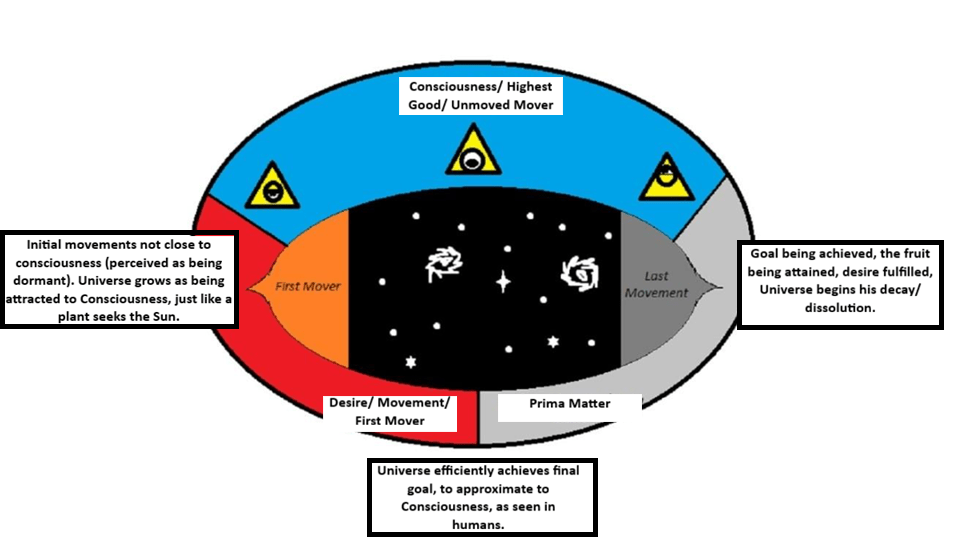
Our observation of the phenomenal world as perceived by the senses, has given us clues that manifested existence moves efficiently, and is ruled by a set of natural laws that, if we track the chain of movements down to the beginning, we have to assume that at some point, there was a First Mover that initiated movement in a quasi-predetermined way. A First Mover had to “create” phenomena by an action that I cannot find a name for other than “willing,” or perhaps, “desiring.” For that reason, before everything was manifested and created efficiently, it had to be desired in that way, and that very same “will” is the Law that now governs our Universe, and the laws of nature remain the same in as much as the will of what I have to call a Creator, aka the First Mover, hasn’t changed and is ingrained in the whole of manifested existence. Now, I cannot imagine a “willing” without a specific Form to will at, and an ultimate will that cannot be other than the Highest Good that perhaps requires intermediate Forms as means. I cannot imagine a Form without a Consciousness that focuses its observation on the Forms that Matter is to take.
If we follow what science has to tell us, that there was a Big Bang, and as the Universe cooled down and expanded, the rules that were settled (or pre-existing) during those first milliseconds of manifested existence are now the laws of nature that we observe today underlying the phenomenal world as perceived by the senses. Have the laws of physics always been the same, or were they bent in those initial periods, or would they be bent as the Universe approximates its death (either in a Hyperinflationary, Deflationary, or Freezing event), I cannot tell. What was there before there were any laws? Could it be a Consciousness and a potentiality of Prima Matter with the desire of being observed?
Imagine a person that threw a stone into a lake, and the sinking of the stone caused ripples in the water that expanded, that cannot be reversed, and that cannot be stopped until they disappear by themselves. In the same way, a First Mover had to “will” the Universe in a specific way, and for a specific reason, aka., allow a Consciousness to observe it, and after the initial “will” the Universe keeps expanding as the ripples of that First Mover until the reason for what everything was “willed” is fulfilled, and the ripples disappear in a dying Universe. The lake and the ripples in it would have no idea of what exactly initiated the rippling effect, and the First Mover, the person who threw the stone, would remain unseen, yet, the First Mover “oversees” the effects of what he started, without being able to reverse the chain of movements that he initiated. In what way was it “willed” this way and no other? Perhaps it is not for us to ask why the Universe is the way it is and not otherwise, for it is this way already.
Can another First Mover appear and throw more stones to the lake, in which case the ripples will have more than one efficient cause? In other words, can new “wills” with new natural laws appear randomly? If that were possible, I would say that the First Mover, and whatever multiplicity of Movers can pop up, all of them are of the same quality as Demiurges of Movement. Ripples in the water would then, consolidate into bigger ripples, and we could assume that the efficiency and the finality of movement is not impaired since the Matter on which it is worked on, and the finality it initiates is the same. Perhaps there were multiple initial Big Bangs, or perhaps there are today Big Bangs occurring in those confines outside of the observable Universe. We may never know. Can we, humans, “will” differently than the First Mover, perhaps even the opposite? If that is so, throwing more stones wouldn’t eliminate the big wave initiated by the Creator, but merge into new ones. This may be the origin of evil, that is, the willing of things opposite to our Nature and our purpose in this Universe.
Synthesis of West and East – Samkhya philosophy.
I want to stop again, although my reader must have most likely noticed, and remind myself and everybody that I have been speculating all this time along. What I’m going to propose is a mere synthesis, guided by the few things we deducted through reason and experience, and what I have borrowed from my studies in Samkhya philosophy from India. I also don’t know how much is western science acquainted with Hindu philosophical systems, but so far none of that impression has reached my eyes or ears.
That philosophy, when translated in Westerner philosophical language is the following: we know that there’s Consciousness, and there’s phenomena to be conscious of. The purpose of phenomena is to be observed by Consciousness. The moment that Consciousness is not present, then phenomena should not occur. The teleology of the dynamic (or what happens in the end) is that Consciousness detaches itself from phenomena and remains free in his own essence. This can only be accomplished via human beings. As human beings, we have an internal mechanism known as free will that allows us to differentiate between things, and to pursue that which we believe is most meaningful. In humans, the pre-determination of the instincts is the weakest, hence, we can go against our Nature (of the instincts). Therefore, what separates us from animals is that we can reason, self-reflect. If we reason properly, we could, eventually, achieve the cognition of the differentiation between what is the Self (pure consciousness) from the not-Self (phenomenal world and its substratum). This is, in short, what this philosophy consists of. This ceases the apparent existence of the mind for that ego, that now ceases to suffer and to desire.
Let us continue. For the observation of my own individual consciousness, I know that I’m not always conscious, like when I’m sleeping, in deep meditation, intoxicated, or unconscious. Also, the quality of my consciousness varies throughout the day, and sometimes I’m fully conscious, perhaps working on a task, observing a landscape, or observing my emotions, while other times I’m semi-conscious, like when I’m day-dreaming, forgetful, distracted or trying to fall asleep. The only way to be fully conscious is to “focus” on a thing, and deliberately ignore other external or internal stimuli. I also notice that consciousness requires some effort and it is difficult to maintain. Even during the most creative of experiences, the person that can focus on a thing and be fully conscious cannot do so for more than 3-4 hours a day. Consciousness is also the rarest of things in the natural world, though I cannot prove that a rock, a tree or an animal have consciousness, I can say that humans seem to have higher and more differentiated levels of consciousness, and for that reason, nature has rewarded us more than the animal kingdom. For some reason, nature rewards disproportionally consciousness, despite it being surrounded by unconsciousness everywhere.
Therefore, I’m going to venture in saying the following: the Universe was “willed” by a Creator, or perhaps it is self-willed, whose goal is to be in a creative state of flow. Matter, the Demiurge and the World of Ideas are also eternal principles that exist unmanifested, and they manifest when they combine among themselves in the presence of a Consciousness. What is the smallest thing to focus on if not a point, instant, a particle? That first initial act of Creation, the First Movement of what was moved by the First Mover was an act of incredible Conscious focus on what was unconscious. What happened after that was a withdrawal of the creative act from what was unconscious into what now can be observed because it was created, so the Creator turned into a passive observer of the ripple effects, of creation, or it simply disappeared, or re-appeared in humans as the ego who can focus consciousness onto its Creation. What we perceive today is a sort of inertia of Movement initiated by the Creator, and the underlying principles of Movement, Matter, Form naturally seek to return to their unmanifested state of equilibrium before being activated by Consciousness.
Therefore, the end game is a detachment of Consciousness and a return to unmanifested unconsciousness, given that there’s no more fuel (desire) to ignite more creative Movement. Science refers to this as entropy and the dead of the Universe. However, the death of the Universe does not guarantee that a new Consciousness would not arrive and set up a new Universe. Where this Consciousness come from, or where Matter, Form and Movement come from, or why there’s existence or God is not for us to question. However, based on my observation of my own individual consciousness, I can say that the Universe resembles me in more than one way: 1) I come from unconsciousness, born into consciousness, and will die into unconsciousness again; 2) I’m conscious during the day time, and unconscious at night; 3) when I’m conscious, I’m not always fully conscious and most of my waking life is automatic and without focused reflection. The Creator had to focus into a state of focused flow, like any act of genuine human creation, and like children with no memory. Later, like the artist that stops to observe its work of art, the Creator stopped and became a passive observer that oversees the ripples of its Creation as they happen. Ultimately, it will detach itself from observing the Creation and rest, or get ready for a new Creation act. What role do we humans have? What does it make of us, knowing that we have consciousness?
Perhaps, I’m stepping on a different topic, but I would venture to say that human beings, as created themselves, participate of consciousness, and for that reason, are co-creators and co-observers with the Creator. Maybe, the only way for new Creation to occur, given that most of the change/movement seems to be pre-determined (pre-willed) by cause-effect (efficient cause), is through human consciousness, as we have access to the causeless cause: that of observing observable phenomena, and the “willing” of new things that previously were not determined to exist. Given that the material we would use to “will” things is the same material that this Universe uses, aka., Matter, Movement and Form, we will create things by willing them meaningfully (final cause) in a way akin to the laws of the Universe, which are also our laws given that the ingredients we draw them from are the same, and so we set that new chain of movement through creative effort to be handed over to the bigger ripples of the Universe to carry it. So, for example, I will to move my arm (which consists of Matter, Movement and Form), that by itself without my individual consciousness is just dead, and will move and decay according to the pre-determined laws of nature, as it is coded in nature it would happen because it was meaningful; however, I’m alive and have consciousness and a will to move it, so it would move and ignore the pre-determined “will” of the Universe and follow my individual “will” toward a final cause that is meaningful to me. Let’s say I move my arm to reach an apple to eat, but I could’ve chosen not to move it, or so it seems to me. Because I chose to move it, that will set up a new chain of movement within the current framework of the laws in the Universe that started, perhaps, with the electric charges in the brain that sent the command to the arm to move. In this case, the final cause of this movement consisted in a “substantial change” for the apple, and an “accidental change” as well as locational for the arm, because it was meaningful to my and my survival as a carrier of consciousness.
Some people would say that the Movement of my arm was pre-determined because I followed an impulse that was “willed” beforehand and was encoded in my nature. Granted, I cannot deny that the tendency or predisposition was present, and that perhaps all I can do is observe how my brain thinks, makes decisions, etc.; that I don’t make anything happen but that things happen to me, and in that way, I’m just a passive observer: the arm just moved to grab the apple, and I just observed it as it happened. I also observed how a feeling of “power,” or authorship happen to me as I see the arm being moved. Before I continue, I have to ask, what is the “I-ness” that I observe but that is impermanent, and what is my individual consciousness that observes?
I cannot do otherwise than to remember that consciousness is what creates by simply observing, or focusing on the observed thing. Now, I ask, in what way and capacity do I chose what to focus on? Wouldn’t “free-will” consist primarily on our autonomy to “focus” our (access to) consciousness into whatever we choose to? If the “I-ness” is just something that happens, and all the thinking, the feeling and the perceived by the senses is just phenomena that happens in front of my consciousness to observe, just like a movie, a pre-determined film to the eye; then how can we explain that we’re not conscious of everything that is happening and need to focus on one specific phenomena to observe from the multiplicity of phenomena occurring simultaneously? How does that focusing happen, because we cannot certainly be conscious of everything at the same time? How do we discriminate what to observe and act on? I could explain “free-will” as the feeling of autonomy, that after all feels empowering to the “I,” and as an emotion exists, but does it exist as a fact beyond emotion? I cannot prove nor disprove “free-will,” but I would point out at the fact that we can focus and discriminate on what we observe as it happens around other things that happen simultaneously.
Then, we’re observers, co-creators and passive created entities at different times, and all at once at the same time. We did not “will” to be borne, but were “willed,” and we “unwilfully” were “willed” to die; and sleep, heart beat, muscular reflexes, etc., happen to us because they were ingrained and “willed” into our nature. We can also focus on one thing and discriminate others because we “will” it, now because an emotion crossed a threshold, or an external danger threatens us, so we focus on the phenomena that wants to be seen, but now and then we shut down external stimuli and the emotions and focus on an idea, or a calculus problem because we “will” so. And how to account for those creative states of flow in which we’re conscious on our work of art while being unconscious of everything else, and we forget even our conception of time? I pretty much prefer the hypothesis that we have “free-will” when we’re operating in the capacity of co-creators, and to a lesser degree, of observers. Enough of free will for now. This deserves another entire essay.

 Oscar Najarro
Leave a comment