
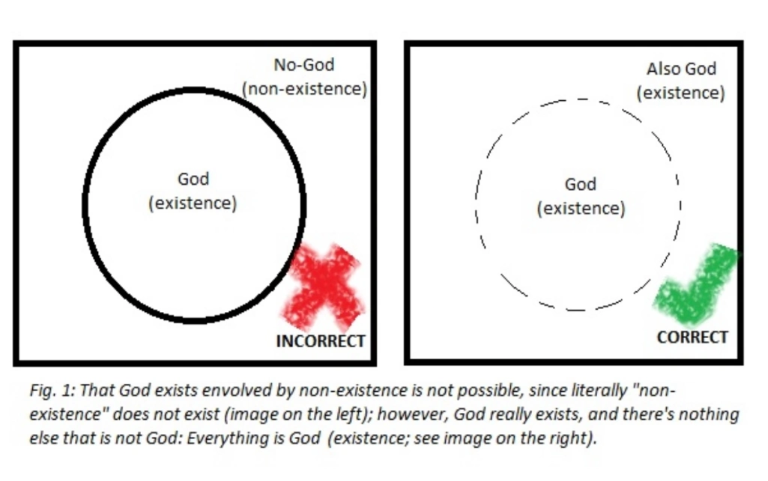
From Parmenides and Heraclitus we get that non-existence does not exist, whereas existence is all there is. See the following image:
We also learn from them that the world of appearances, the phenomenal world witnessed by the senses (internal and external) is the result of a conflict, combination or even a love affair between opposites. They did not offer an explanation on this subject. (A Chad move!)
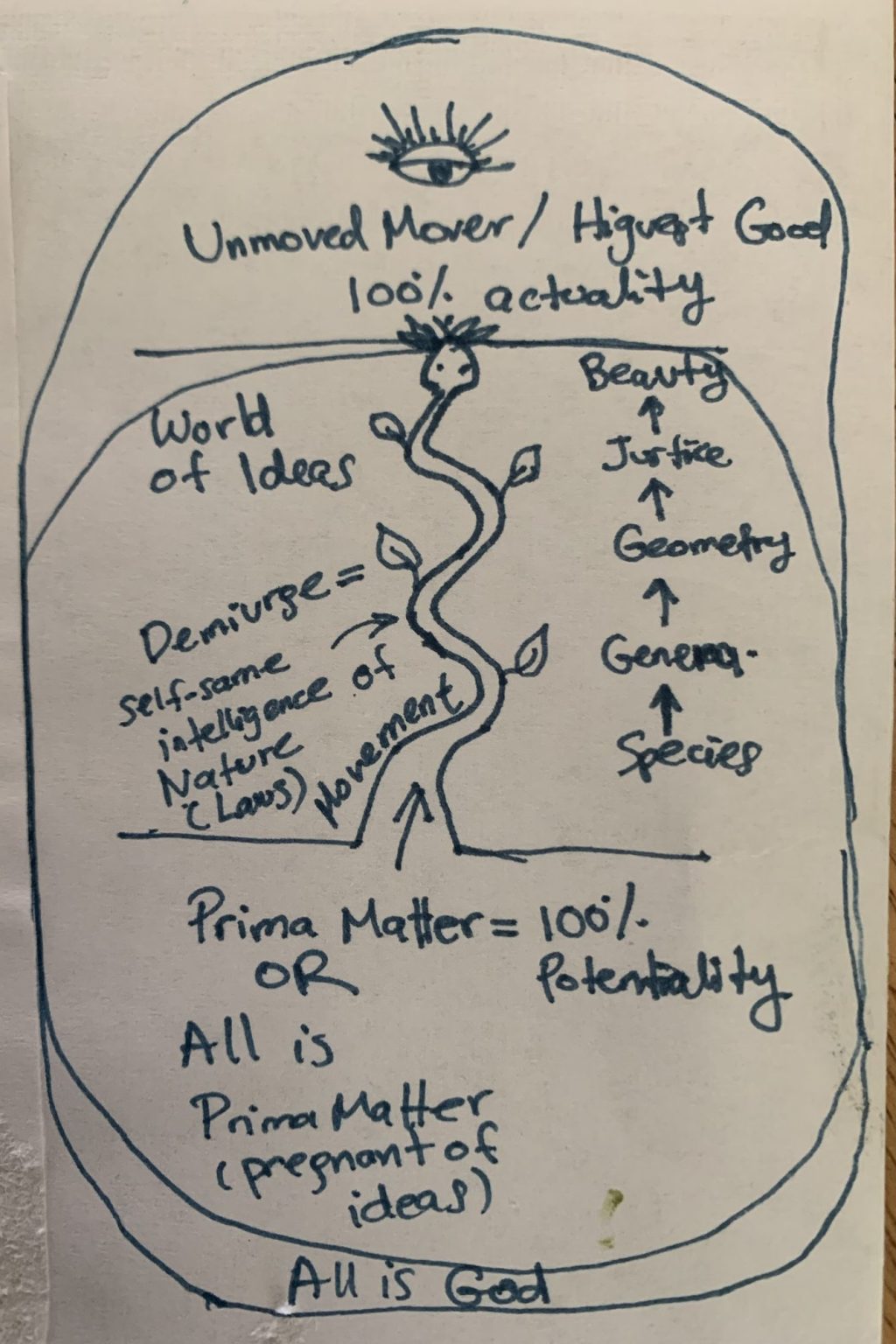
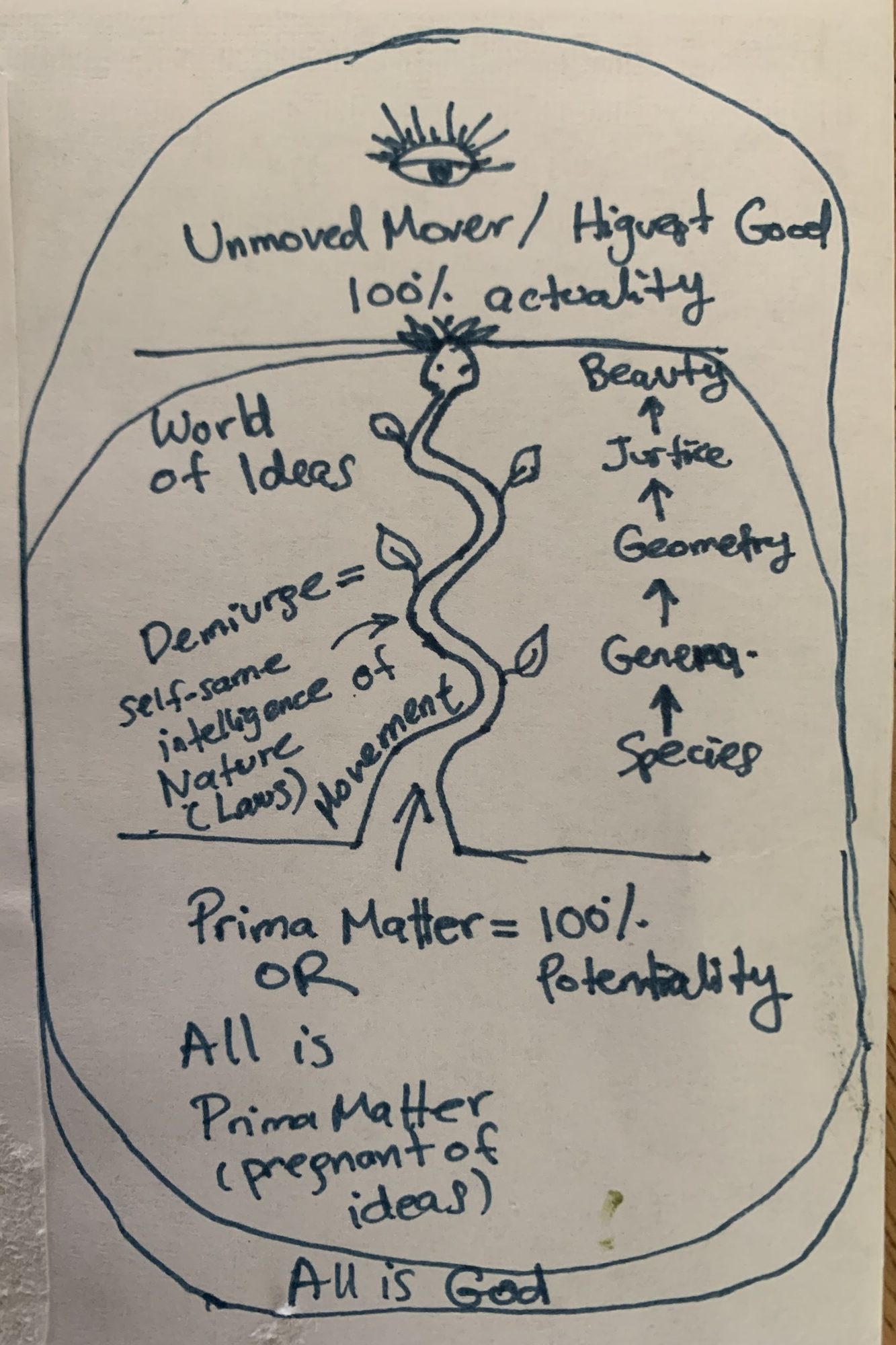
From Aristotle and Plato we learn that these two opposites correspond to an Unmoved Mover (to Aristotle) or a Highest Good (to Plato), and to Prima Matter (to Aristotle, not soo much to Plato who will, instead, attribute it to the material world) that is moved.
The Unmoved Mover/Highest Good is the most actual of all ideas, the ultimate finality that is ever existent, unchanged. This “Self” (as named by the yogis in India) is also attribute-less, uncaused, all-encompassing, not-this nor-that, does not exert itself for it does not desire anything; in turn, it is the desired thing. This is none other than consciousness!
Desired by whom? By the opposite, Prima Matter, which is pure potentiality, which develops, grows, in the direction of her deepest desire: to be witnessed by consciousness. This pure potentiality is in need of being developed, therefore, it is in a constant state of becoming. This becoming is the Universe (of appearances) as we know it. This Prima Matter must have within her, ingrained, the matter that is to be moved, the desire and the energy to strive for the goal, to push her, and the forms or ideas that will serve as means to her desired end, that is, the Laws of the Universe. This version would agree with Yoga-Samkhya philosophy where Parkriti, or the root of the World, does not simply contain matter, energy, forms (tamas, rajas, sattva), separately, but they all are her very essence.
How does she know this Universe has to be in such and such a way, and not in a different way, perhaps we would never know, neither it may be for us to ask the question; rather, it is for us to study it. Can we say a plant is intelligent because it knows how to strive for sunlight? The plant does not think. It simply does. It simply follows her deepest desire. If the desire exists, there should be a way to satiate it (or perhaps not; this we can speculate and experiment about). Likewise, this Universal Laws are such that allow her to fulfill her desire. To Plato, these Universal Laws are the work of a lower intelligence (not that of the Highest Good) but of a Demiurge (which we will grant, because the Unmoved Mover, aka., consciousness, does not desire or act, it simply attracts. The movement is initiated by another).
See the following image:
An analogy: let us think of the Universe as an electric circuit. What initiates the flow of current is the differential in potentials (from negative or ground zero, to positive), and it implies the overcoming of resistance which leaks energy in the form of heat (or work). Likewise, the current of the Universe was initiated by this differential in potential from pure potentiality to pure actuality, and what we witness is the flow of phenomena (the current) that resists inertia, producing works of all sorts, which are not the ultimate goal but the means to an end. To electric current, the goal is not to produce work but to reach the higher potential, and merge with it. Likewise, can we say the current is intelligent? How did it know where to go, or how to perform work?
From the observation of the products of the becoming-world, we conclude that everything that appears to exist participates of the 4 causes (as per Aristotle) of matter, form, efficient and final causes. This applies to the objects of the external world as well as the internal world such as emotions, thoughts, moods, sensations, etc. According to Yoga-Samkhya, these elements are more subtle, therefore participate of less and less amounts of matter, and bigger proportions of desire, forms, etc.
Another conclusion, to be tested, is that humans are the pre-ultimate state of evolution since we are very proximate to consciousness, and we can participate of it. Consciousness is so close to us that illuminates our world in a way we can self-reflect, reason and love. Though consciousness cannot be seen, it can be inferred, that is, we can see the reflection of it in our most subtle (sattvic) constituent parts. The goal of a mystic is to “see” these things clearly, to engage in self-reflection and to use his reason (Plato would agree). This accomplishes the goal, the mind-body complex is destroyed, or rather, dissolved, and detachment from this world ensues, avoiding future suffering.
Definitely a topic to keep thinking about. This topic, we will leave hanging for now.

 Oscar Najarro
Leave a comment